Research partnerships by stage and strategic purpose PowerPoint Template
Editable research partnerships by stage and strategic purpose worksheet with a fictional worked example and a fill-in slide. Preview both pages; download the 2-slide PPTX for 1 credit.
View in library · PPTX · 1 credit
Sign in to download. One credit unlocks the complete 2-slide file; repeat downloads are free.
When to use this template
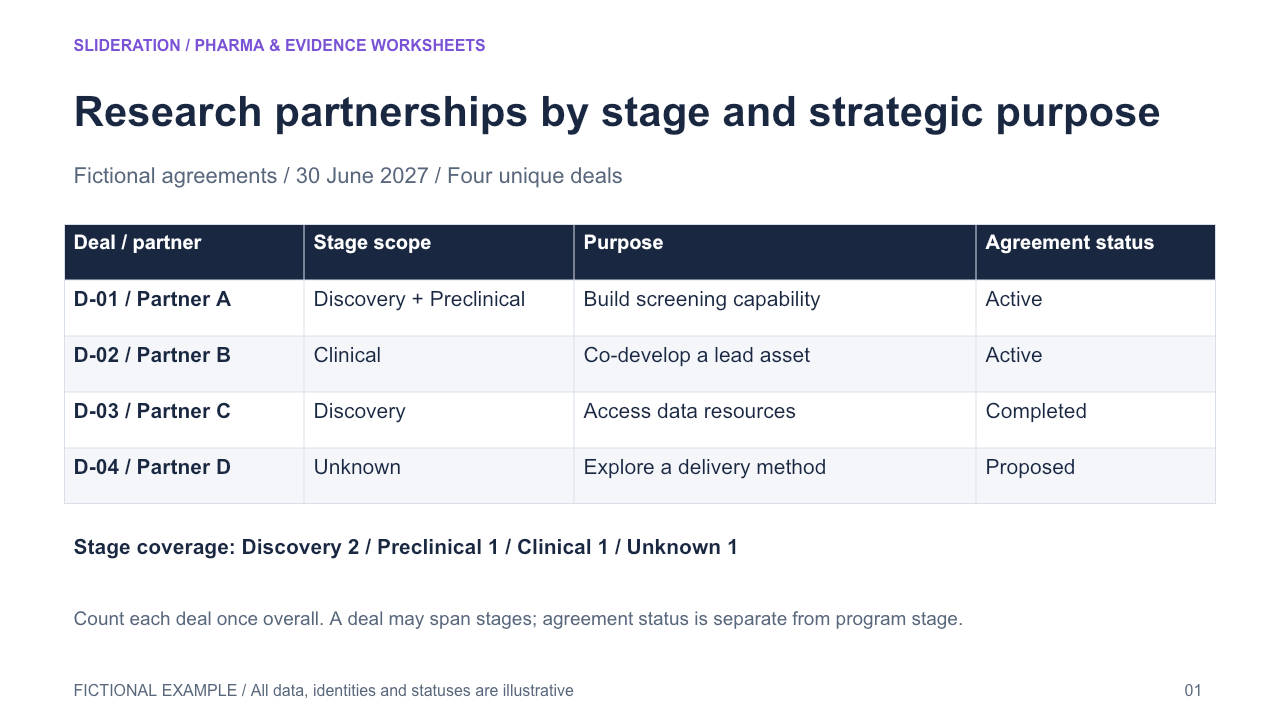
Use one row per stable deal ID and retain both the development stages it covers and its strategic purpose. Existing partner tiles group examples without development-stage coverage, and the pipeline and program register track assets or indications rather than deal scopes.
What you can edit
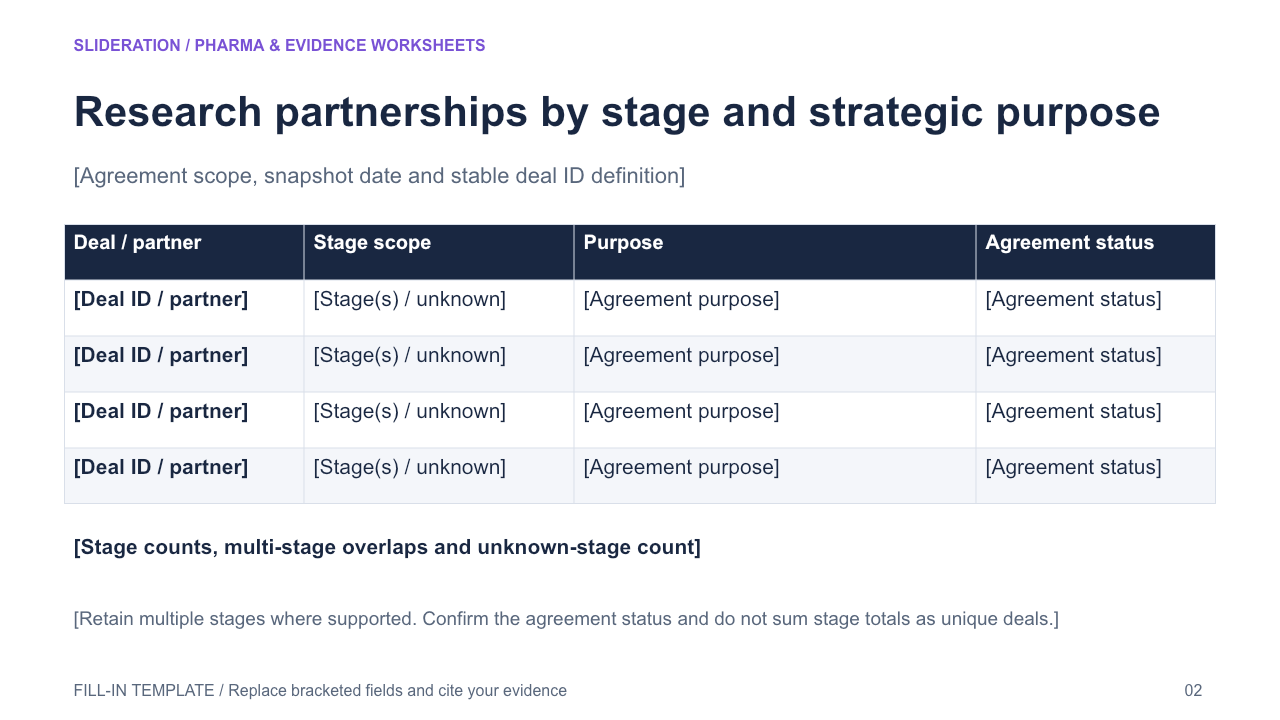
Edit the text, table cells and any native chart data in PowerPoint. The second slide keeps the structure and provides replacement fields. Chart templates use zero seed values on the fill-in slide; replace these together with the associated definitions and tables.
Use the evidence correctly
Use fictional partners and agreement terms. Keep current agreement status distinct from program stage. Count each deal once across the portfolio, retain multiple stages where evidenced and label unknown scope explicitly.
- Define your population, reporting period, measures and evidence sources.
- Duplicate the fill-in slide and replace every bracketed field and chart value.
- Check units, denominators, labels and conclusions against your source before presenting.
View in library · PPTX · 1 credit
Sign in to download. One credit unlocks the complete 2-slide file; repeat downloads are free.
All example content is fictional. Original Slideration template; no company endorsement. Use in your own presentations and client work under our slide licence. Redistribution or resale of template files is not permitted.
Will this fit your material?
- Expression purpose
- Review a portfolio or allocation
- Structure in this file
- Research partnerships by stage and strategic purpose — Use one row per stable deal ID and retain both the development stages it covers and its strategic purpose. Existing partner tiles group examples without development-stage coverage, and the pipeline and program register track assets or indications rather than deal scopes.
- Prepare before editing
- An item register, common stage or classification rules, current status and reporting date.
- Density and capacity
- Use the preview’s existing number of panels, rows and labels as your starting capacity. For more content, split the story across slides before shrinking text. Table dimensions below describe this file, not a maximum.
- Choose another layout when
- Use fictional partners and agreement terms. Keep current agreement status distinct from program stage. Count each deal once across the portfolio, retain multiple stages where evidenced and label unknown scope explicitly.
- Editing effort
- Use one identity per item. Distinguish stage, priority and resource allocation; they answer different questions. This is an editable template, not automatic content replacement. You supply and verify the content.
What can I edit?
- Native PowerPoint tables: 5 rows × 4 columns on the first slide, including any header rows. Edit cells directly.
- First-row fields: Deal / partner / Stage scope / Purpose / Agreement status. Replace these fields and their associated values together.
- No native chart on the first slide. Chart-like graphics use individual objects; update shapes and labels separately rather than expecting an Excel data sheet.
- Text and shapes remain editable. Check the preview for any illustrative pictures; picture content is replaced as an image.
2 slide(s) in the complete file. Includes a worked example and a fill-in slide.