How to build an issue tree from mixed possible causes
Original Slideration editorial exercise · fictional scenario, not a client result. The before/after panels below explain an editorial transformation; they are not screenshots of a customer's deck.
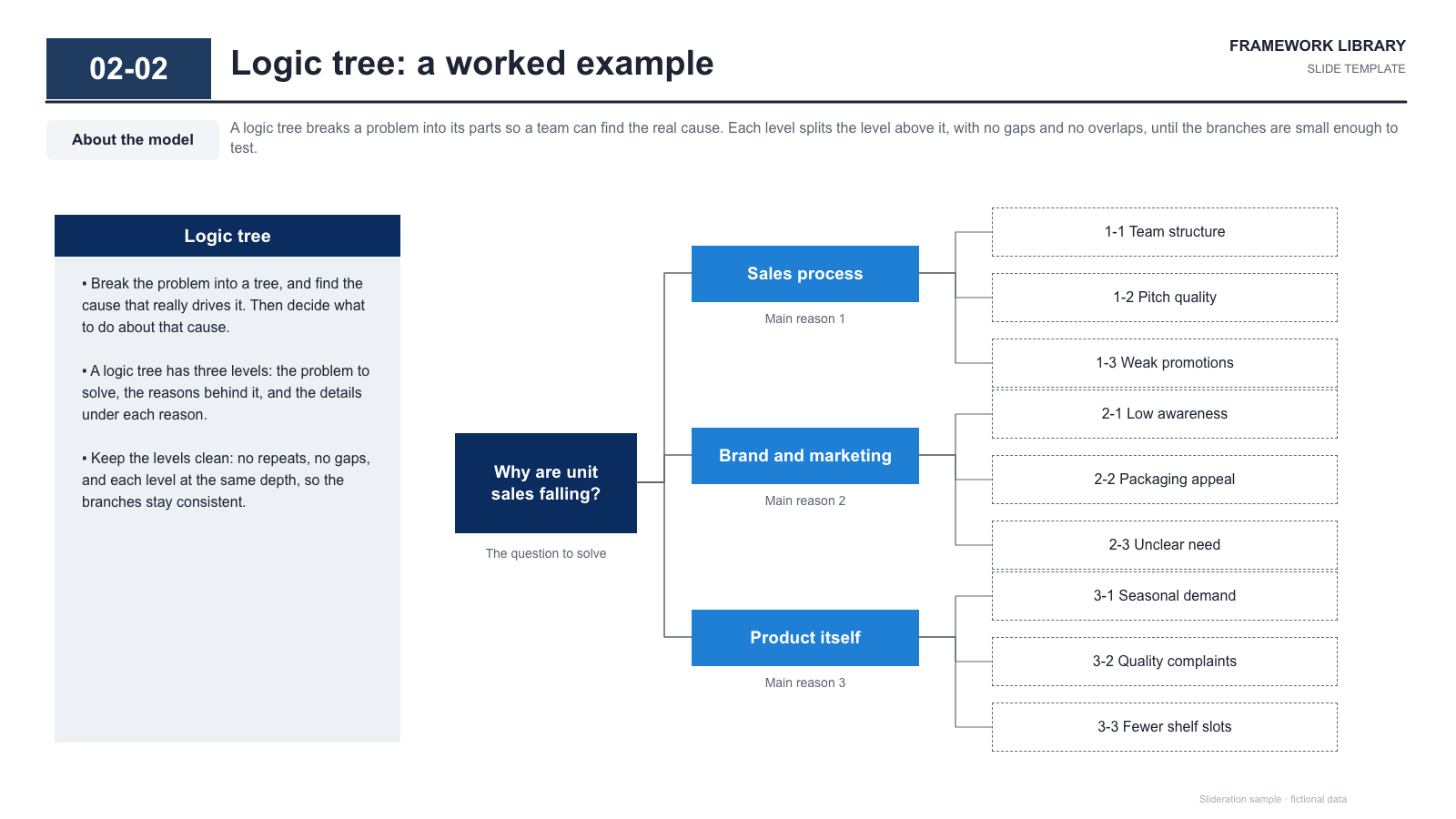
Meeting question: Why are unit sales falling, and which hypotheses should the team investigate?
Before and after: change the hierarchy first
Before: unstructured briefing notes
- Pitch quality and sales team structure
- Low awareness, packaging and promotions
- Seasonal demand and quality complaints
- Fewer shelf slots; no evidence assigned yet
After: proposed reading structure
- Sales process: investigate execution hypotheses
- Brand and marketing: investigate awareness and promotion hypotheses
- Product: investigate product and availability hypotheses
Try matching this sample layout
This opens a public fictional sample in the real search tool. It searches the library rather than showing predetermined matches. You can then replace it with your own screenshot.
Why choose this layout?
A list is useful for collecting ideas, but it does not show how to divide the investigation. We turn the list into a root question, a small set of branches and testable leaves. The d067 sample provides native PowerPoint connectors and boxes. It is a starting hypothesis map, not a declaration that the branches are exhaustive or that one cause has been proved.
Reproduce the transformation
- Bound the root question: metric, segment and time period. Unit sales and revenue are different questions.
- Define branch boundaries before moving notes. Assign promotions to marketing, for example, rather than counting them twice.
- Rewrite vague leaves into checks: compare awareness measures, review pitch conversion or inspect availability records. Specify evidence and ownership in working notes.
- Challenge the first decomposition. Seasonal demand may need a separate external-demand branch; shelf availability may need its own channel branch. Add these if your problem requires them.
Where this approach stops working
The downloadable sample is not guaranteed MECE. Its three branches are an editable starting point. Do not colour a branch as the confirmed cause before collecting evidence. An issue tree is for decomposing a question; a process flow is more appropriate when the task is explaining ordered activities.
Review before presenting
- Is the root question measurable and bounded?
- Do the branch definitions avoid overlap, and what might still be missing?
- Could the team describe evidence that would support or reject each leaf?
Download and adapt the editable sample
Edit the root question, each branch label, the hypothesis boxes, connector lines, explanatory panel and footer. You can add or remove branches using ordinary PowerPoint shapes. Keep the visible tree to two or three levels.
Download free issue tree PPTXNo account or credits required for this sample. Personal, client and commercial presentation use is permitted under the slide licence; do not redistribute or resell template files.
Explore more issue tree layouts · Match your own draft with a screenshot · All three free templates