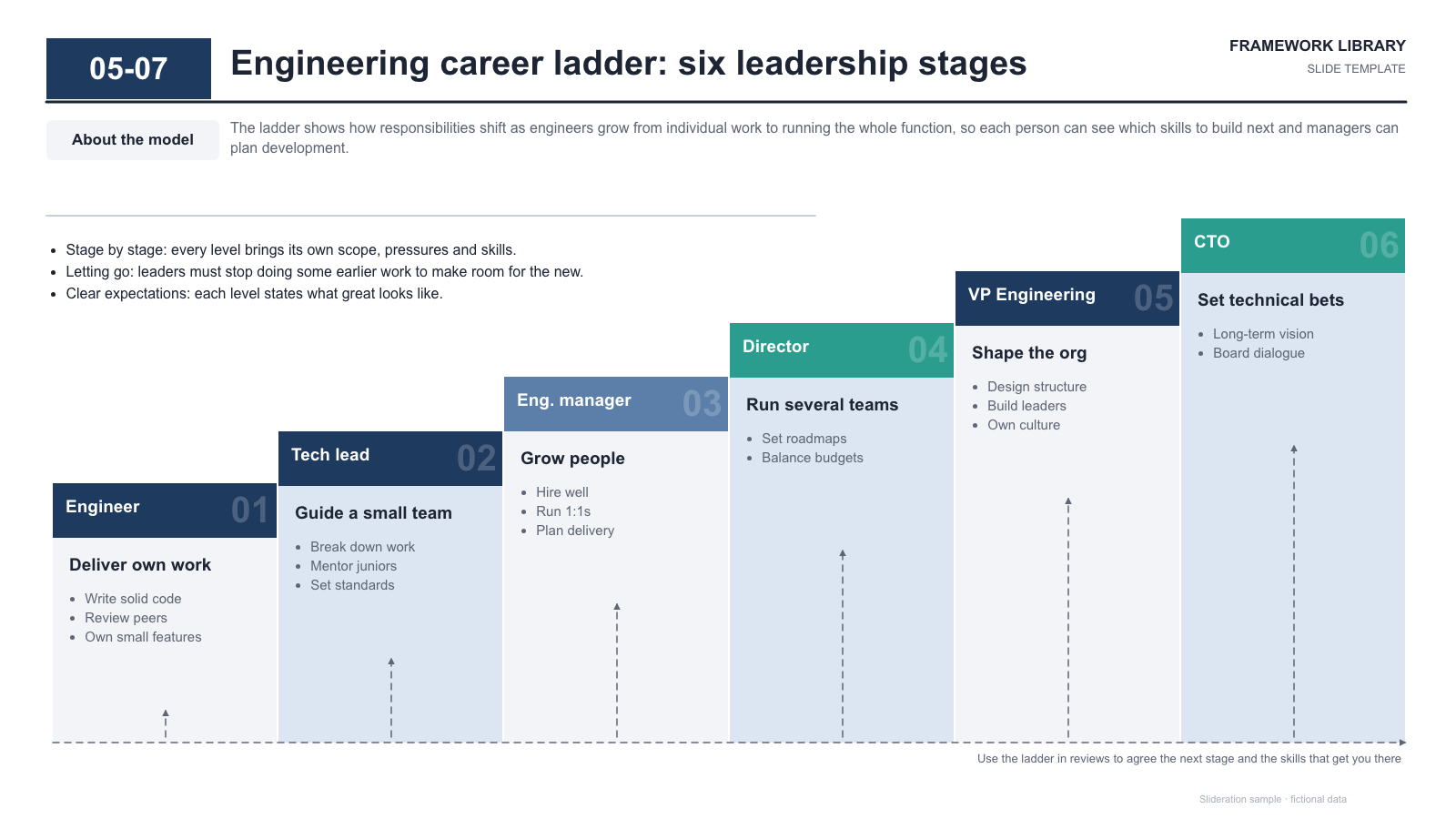
Six-step staircase of leadership stages
Six-step staircase of leadership stages with headers, focus lines and dashed growth arrows
1 slides · 1 credit
Check inputs & editing effort →How does the work move?
Bring: Named steps, inputs, outputs and handoffs; a feedback rule if the process repeats.
Fit check: Do not turn unrelated priorities into a sequence. A closed loop needs a real feedback relationship.
31 editable templates. Open a template to check its structure and editing requirements.
Six-step staircase of leadership stages with headers, focus lines and dashed growth arrows
1 slides · 1 credit
Check inputs & editing effort →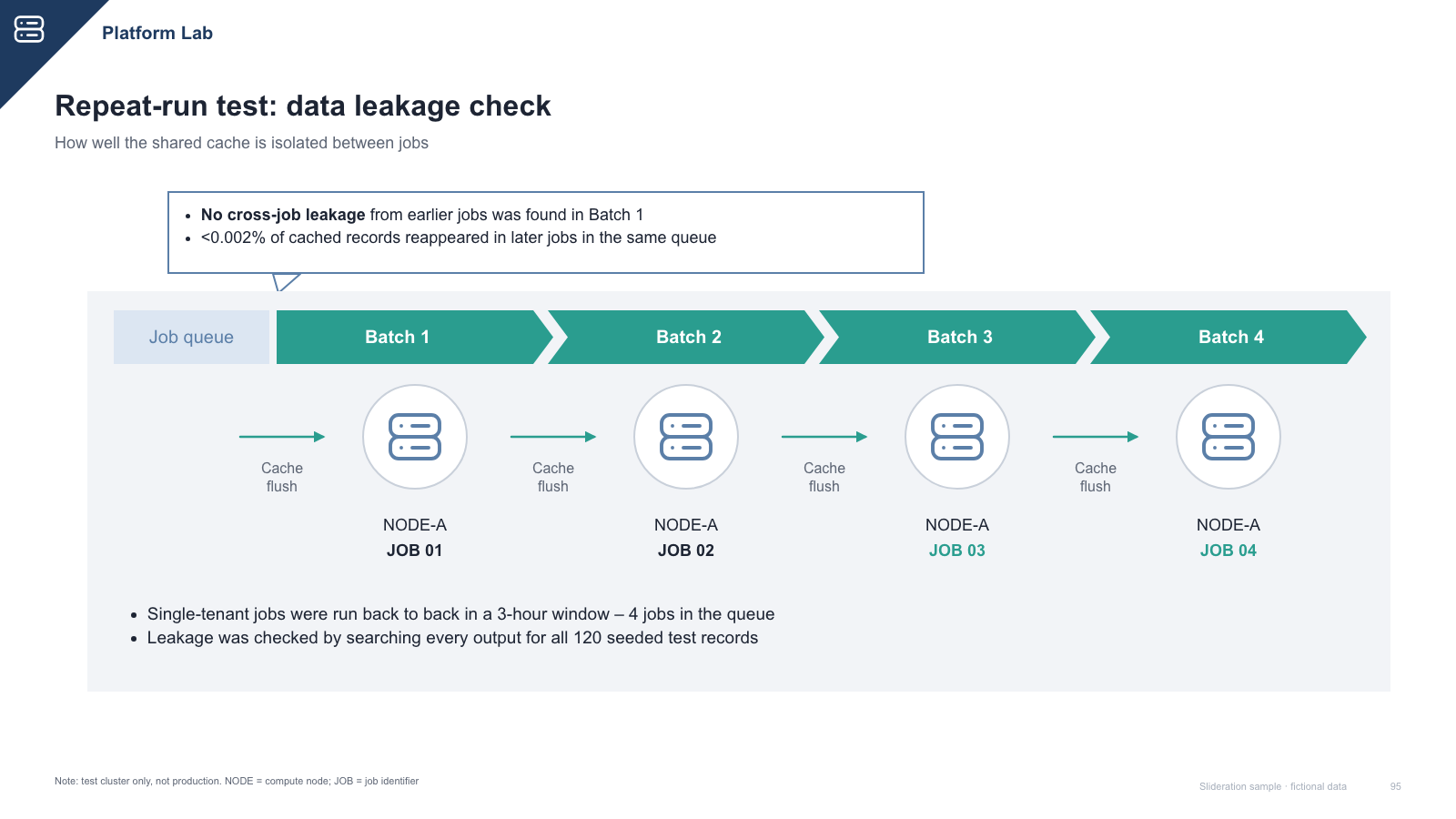
Callout over a process run strip (queue + four chevrons) with device icons, arrows and notes
1 slides · 1 credit
Check inputs & editing effort →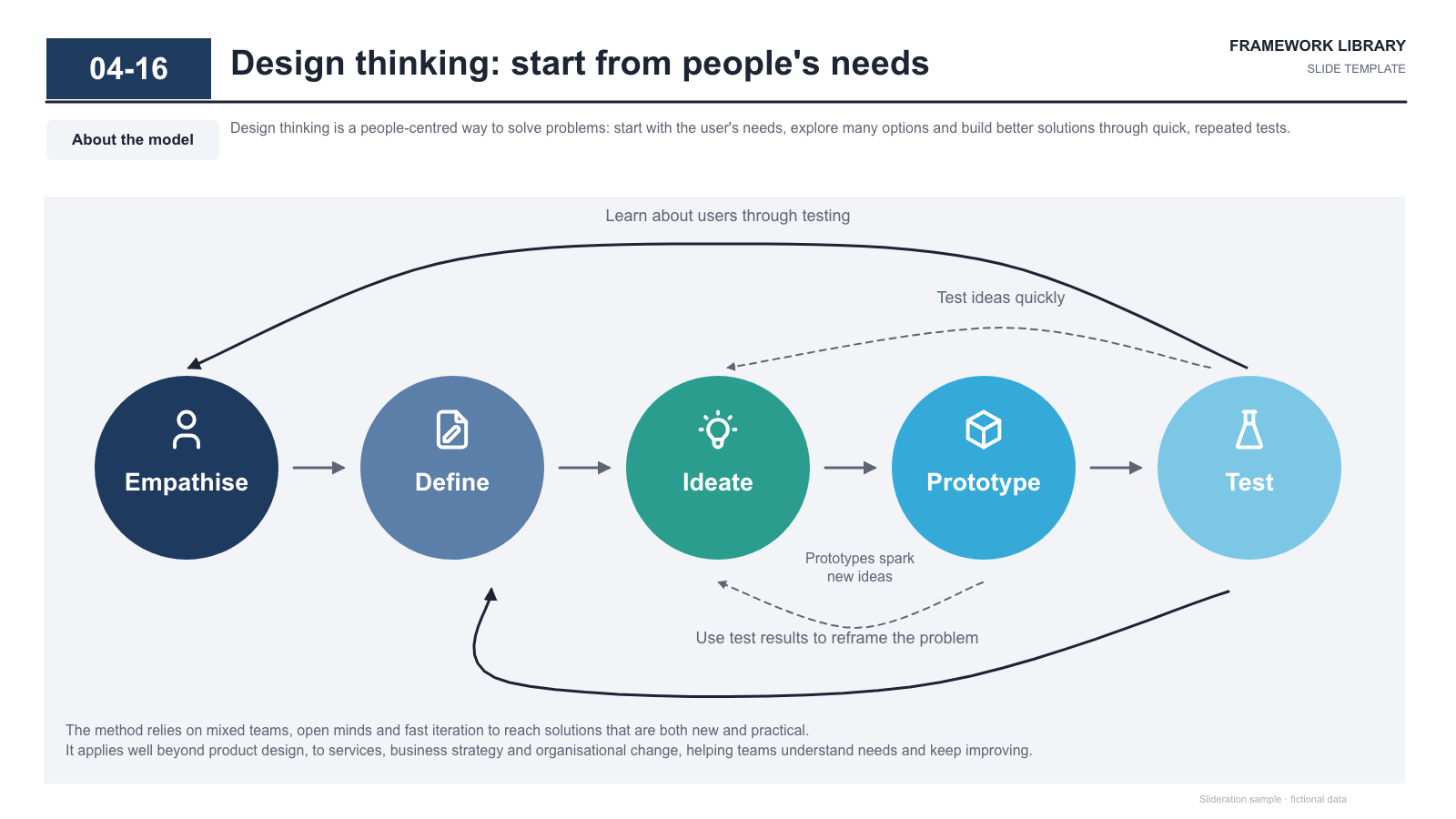
Five-stage circle process with arrows and feedback arcs above and below
1 slides · 1 credit
Check inputs & editing effort →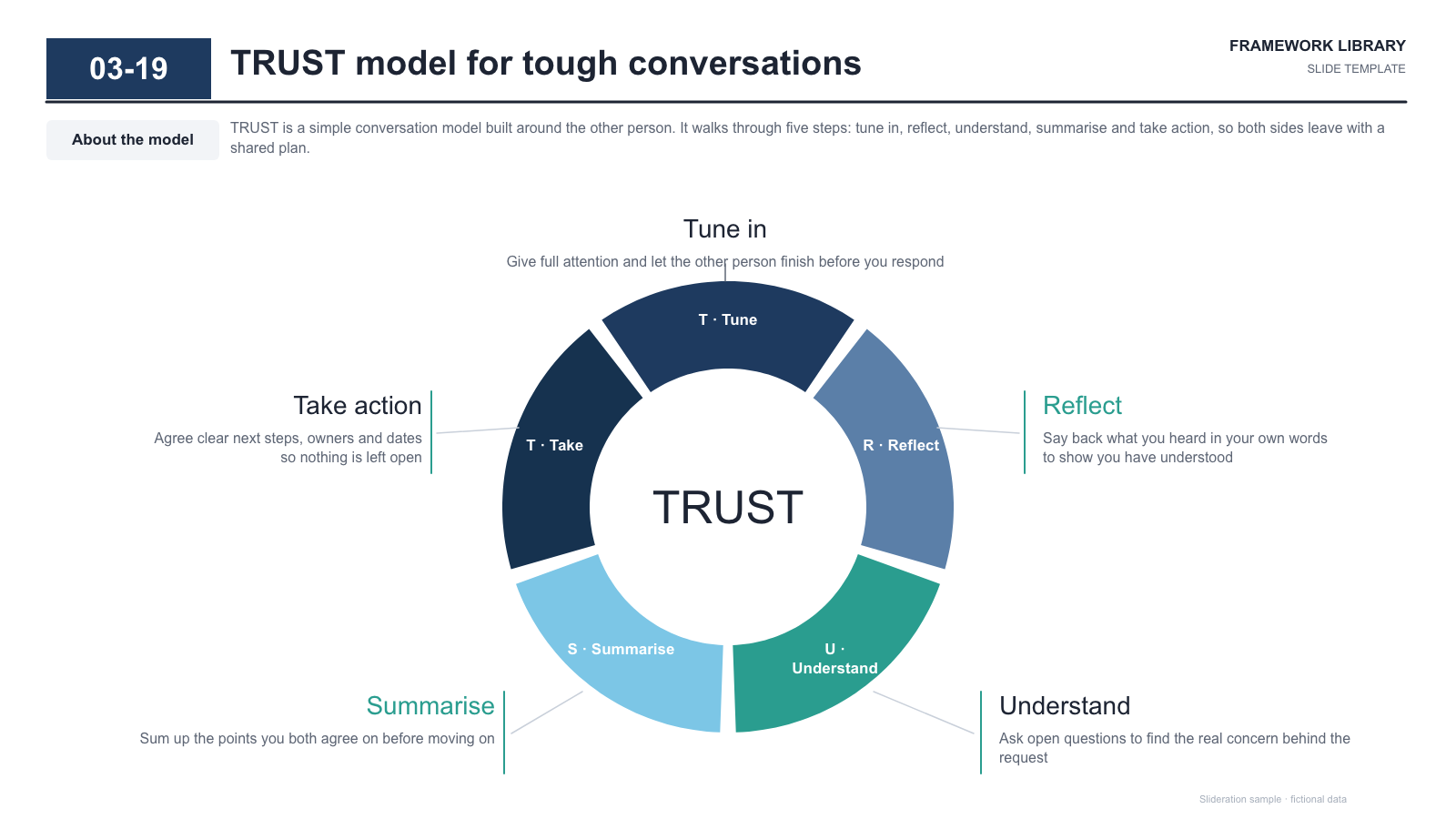
Five-segment ring around a central acronym, with leader lines to outer step labels
1 slides · 1 credit
Check inputs & editing effort →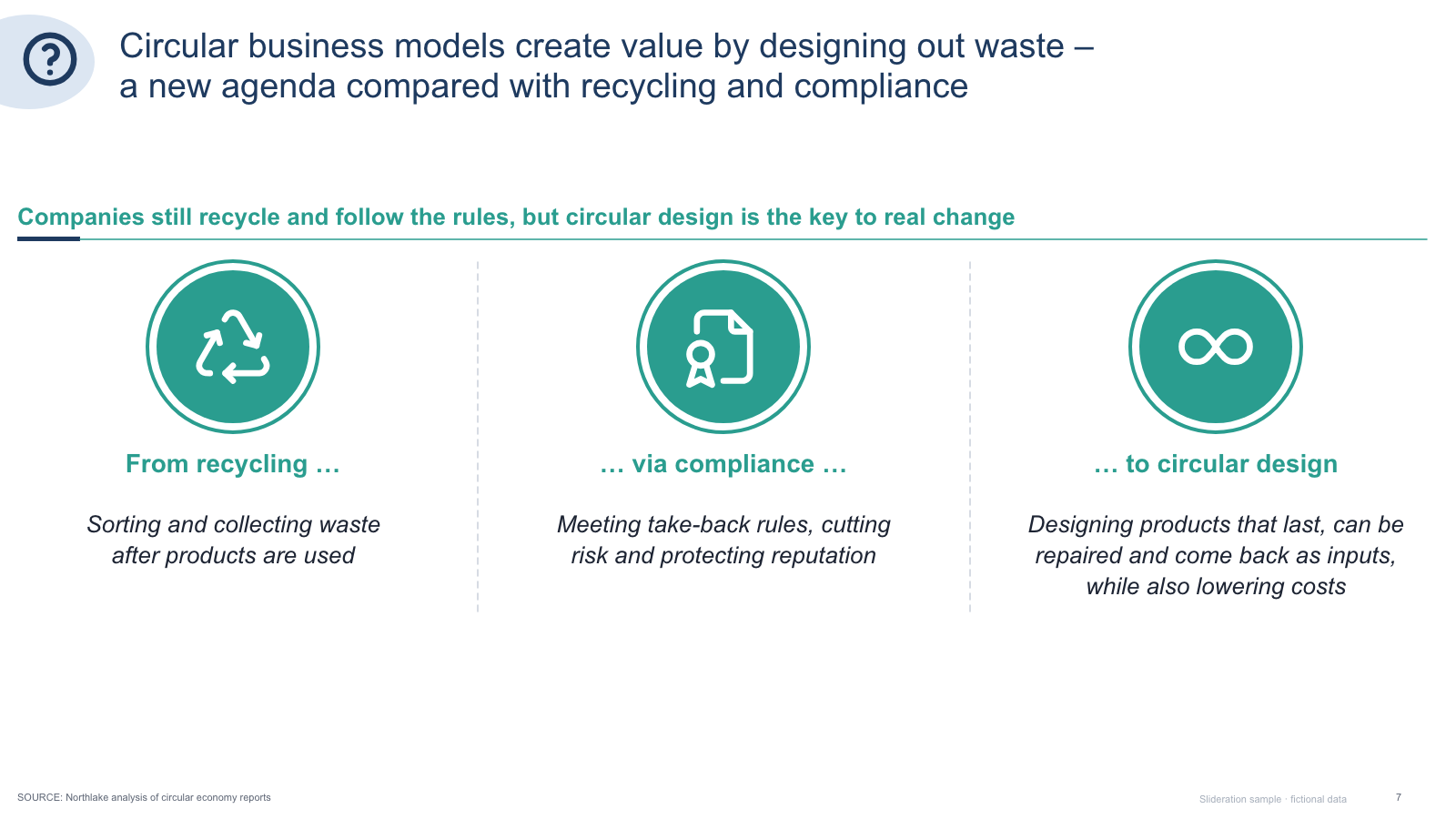
Question badge headline and three-step evolution columns with large icon circles
1 slides · 1 credit
Check inputs & editing effort →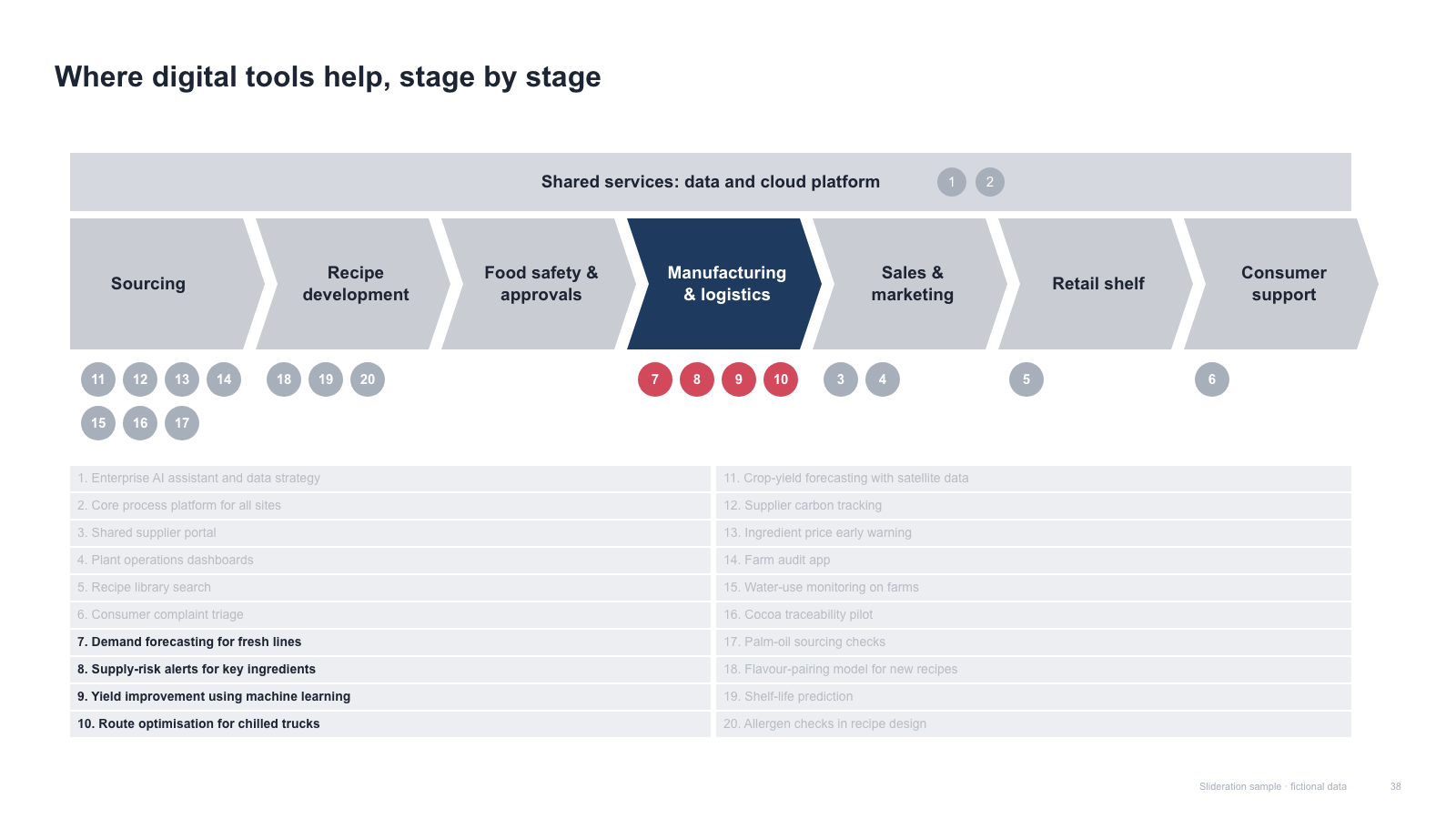
Value-chain chevrons with one highlighted stage, numbered use-case markers and a two-column index
1 slides · 1 credit
Check inputs & editing effort →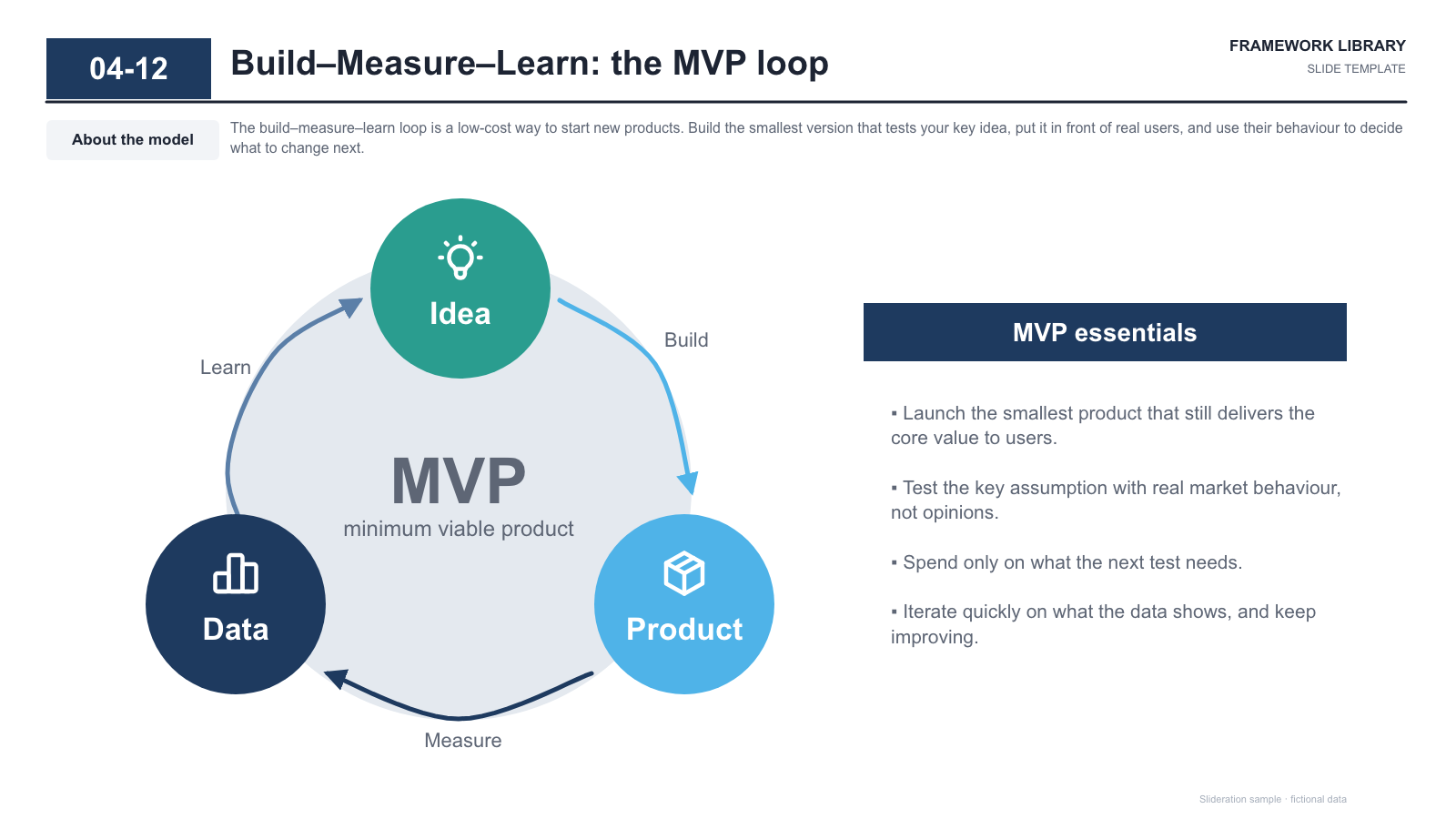
Three-node loop around a large central disc with curved arrows, plus a key-points panel
1 slides · 1 credit
Check inputs & editing effort →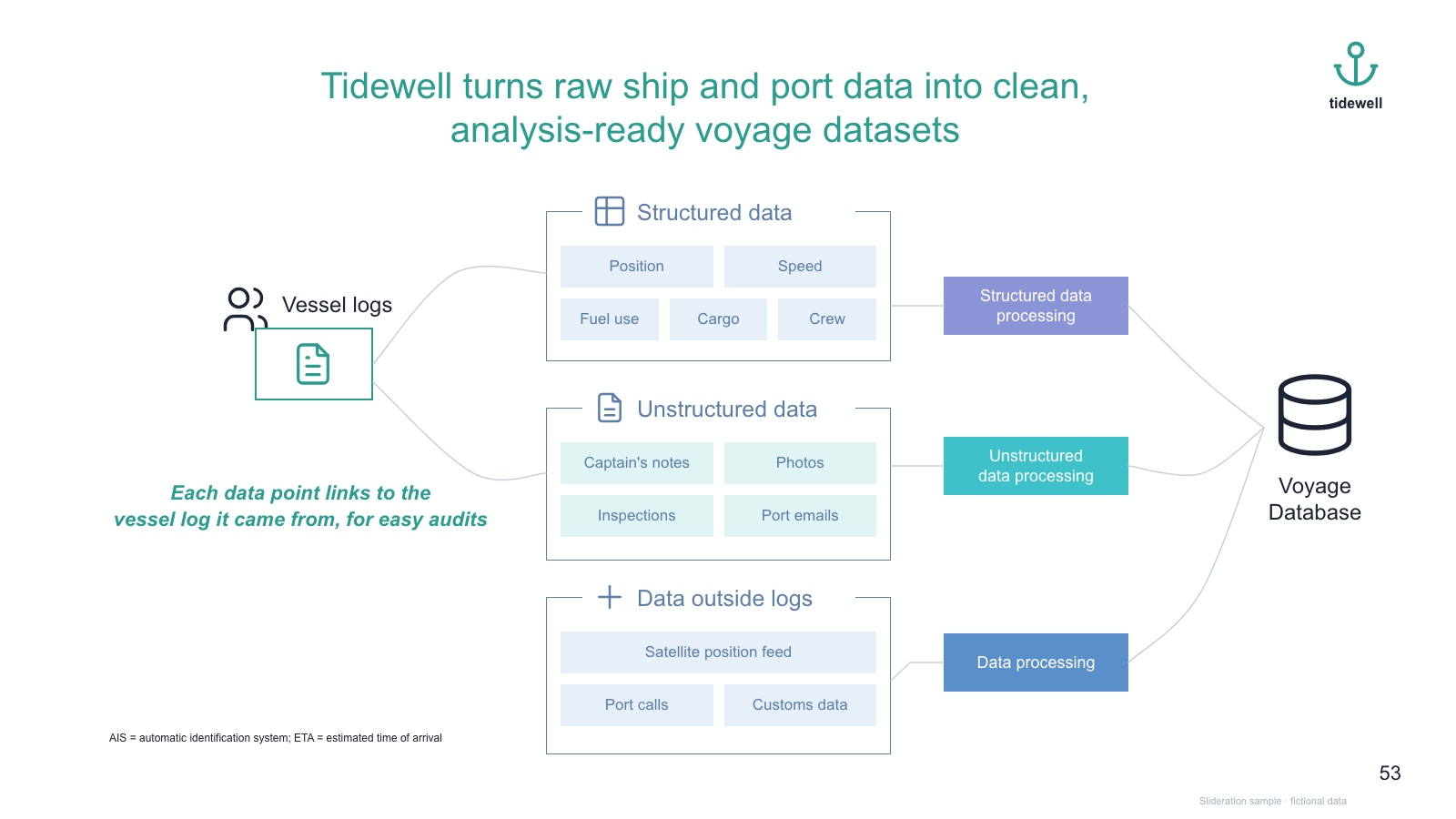
Source-to-database data flow — origin icon, three grouped tag panels, processing boxes and a cylinder
1 slides · 1 credit
Check inputs & editing effort →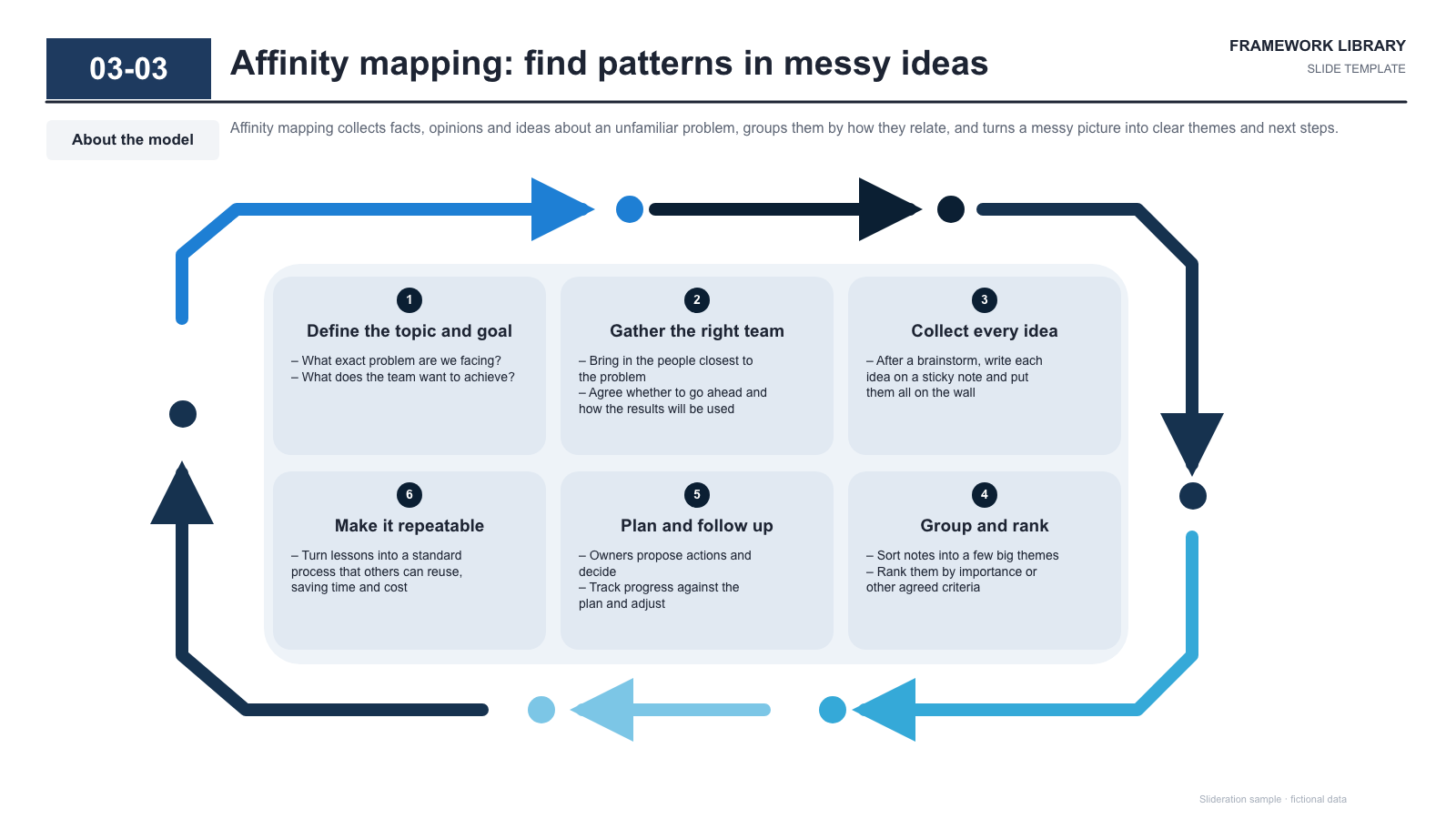
Six-step cycle — rounded loop of arrows framing a 3x2 grid of numbered step cards
1 slides · 1 credit
Check inputs & editing effort →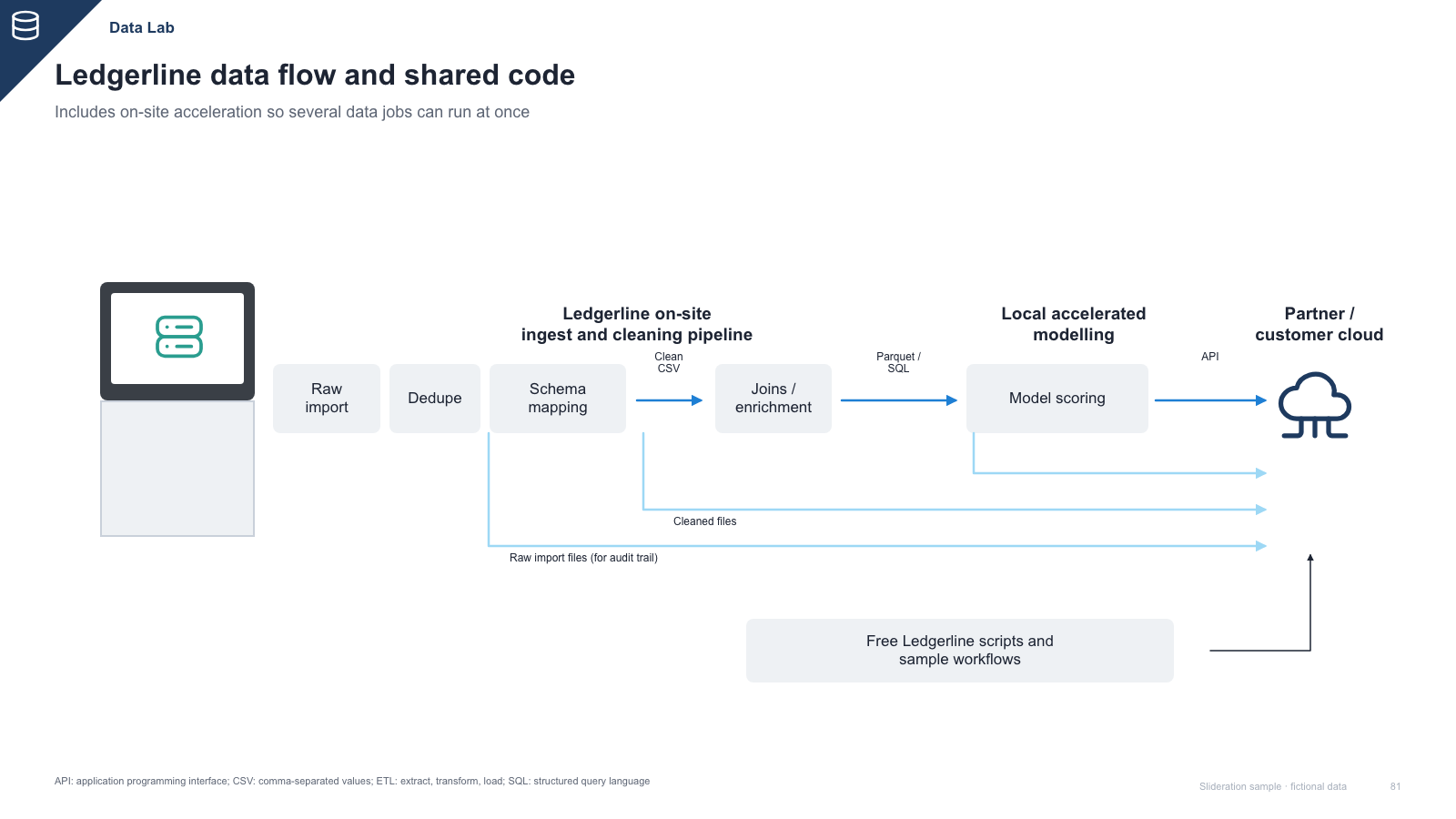
Device image feeding a horizontal pipeline of step boxes with small arrow labels, branch lines and a cloud target
1 slides · 1 credit
Check inputs & editing effort →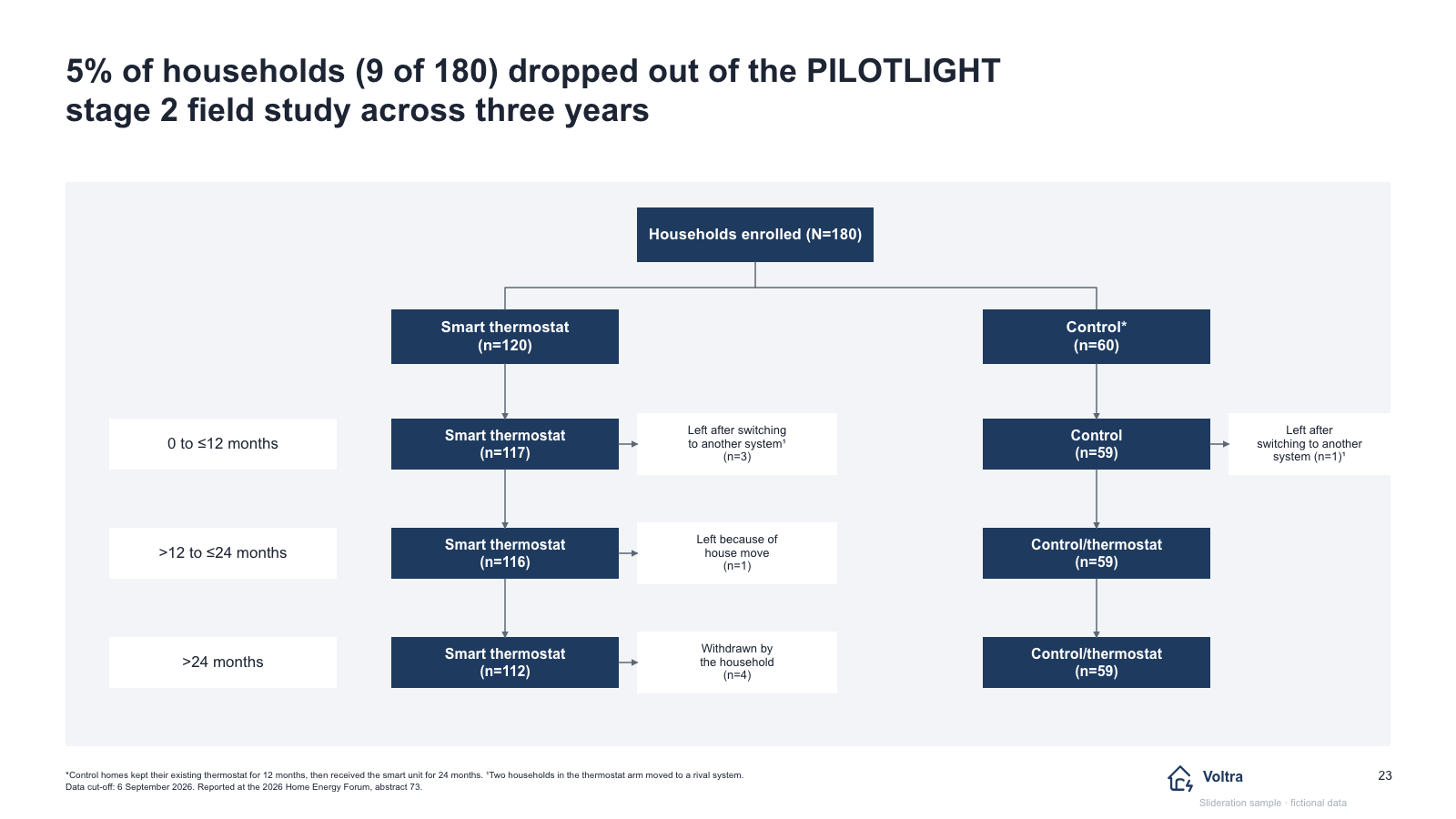
Trial-flow tree — enrolled box splitting into two arms across three time rows with withdrawal boxes
1 slides · 1 credit
Check inputs & editing effort →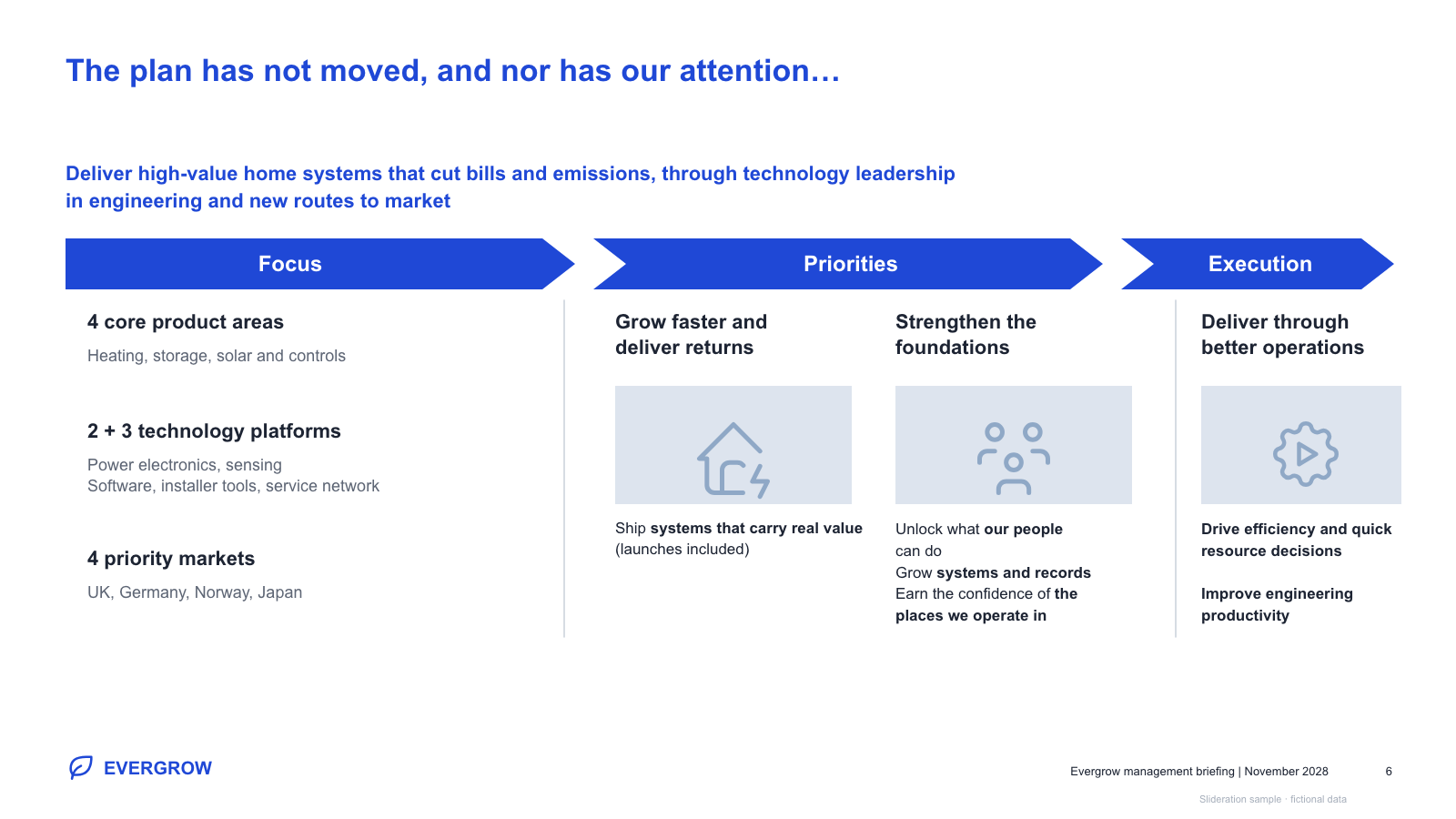
Three chevron headers over aligned content columns with sub-blocks and image placeholders
1 slides · 1 credit
Check inputs & editing effort →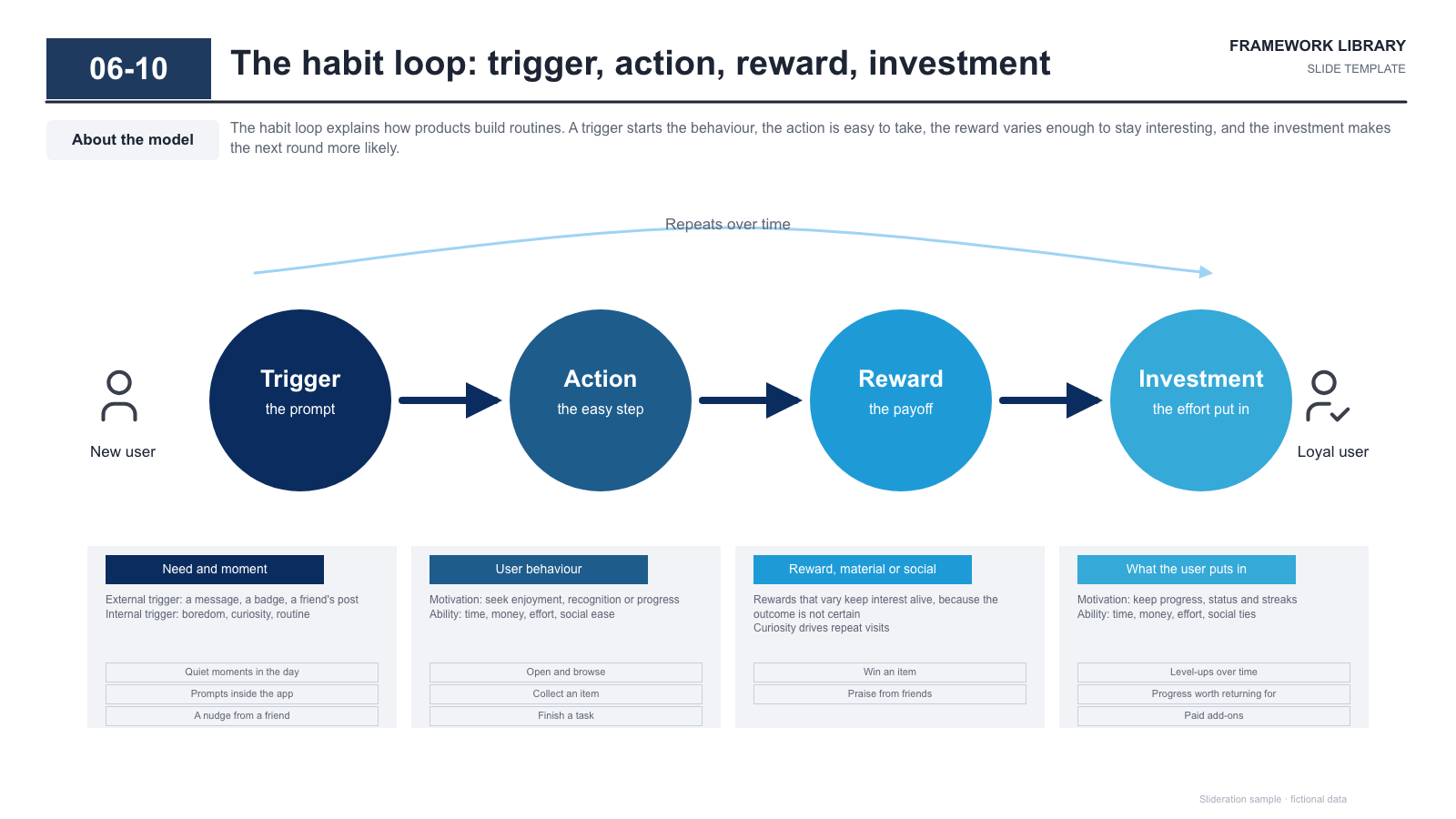
Four-stage habit loop of circles with arrows, user icons at both ends and a detail column grid
1 slides · 1 credit
Check inputs & editing effort →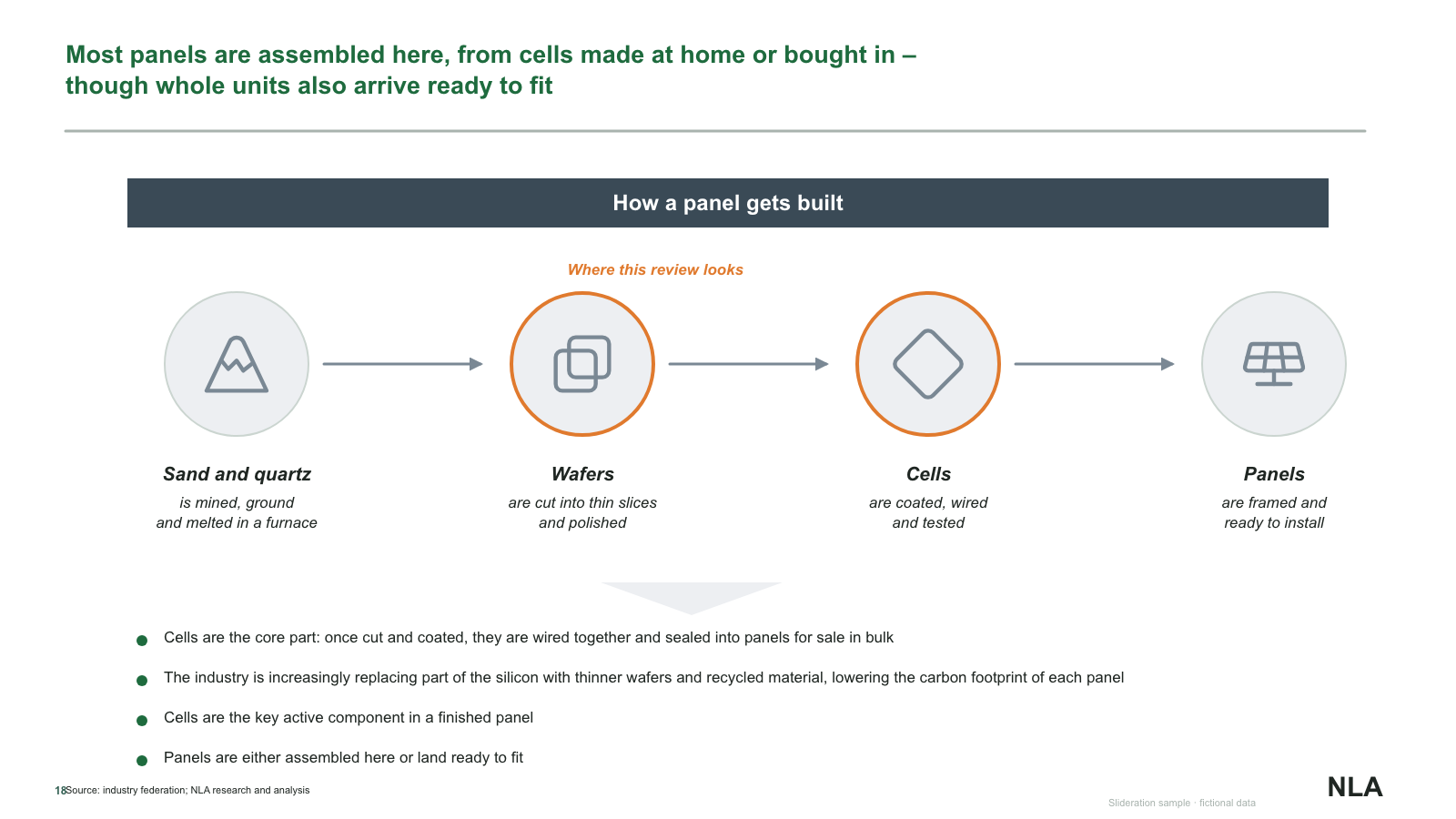
Dark process header bar over a four-step material flow with circle icons and bullet notes
1 slides · 1 credit
Check inputs & editing effort →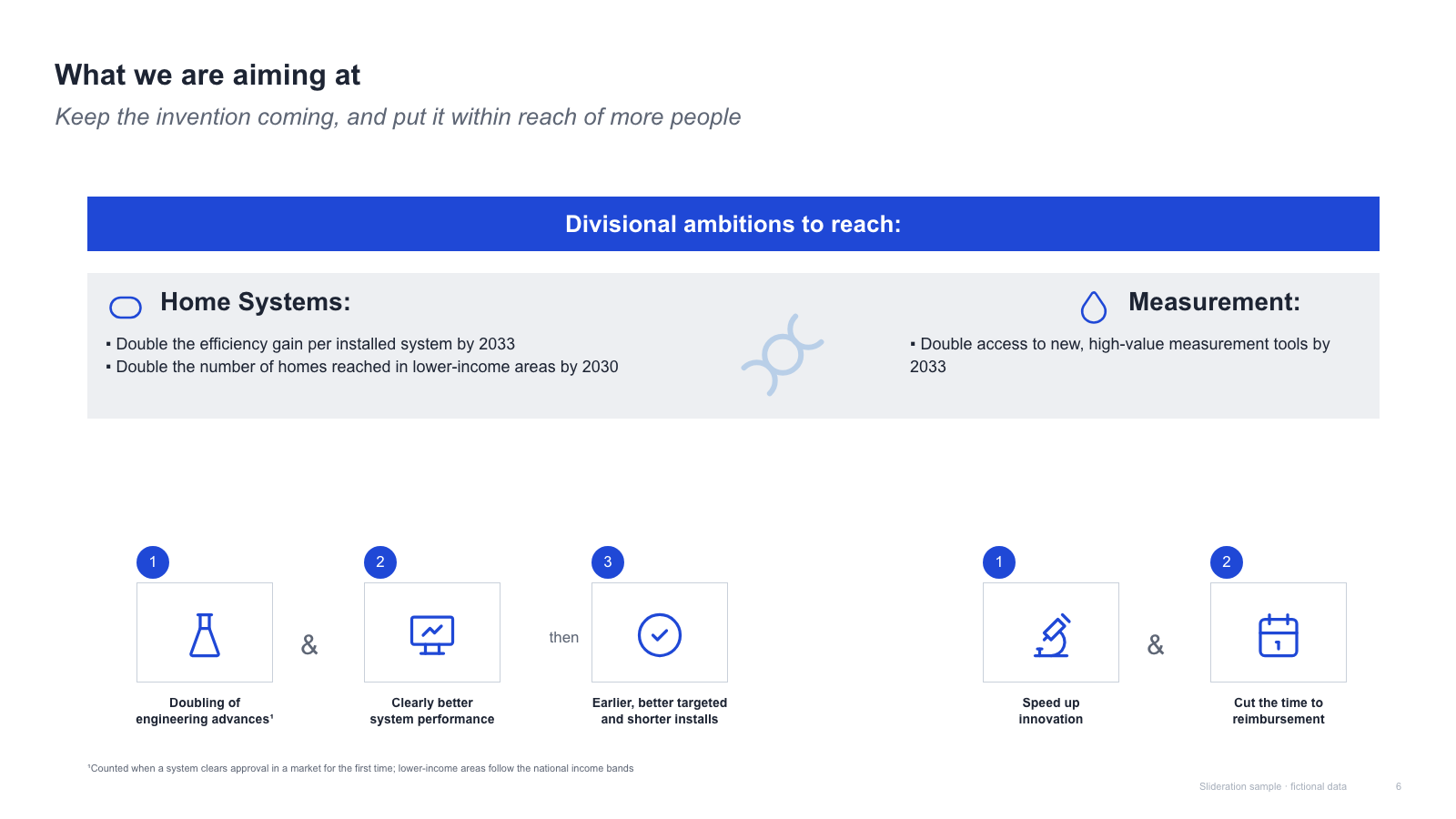
Divisional ambition banner with two wedge panels and two rows of numbered icon steps
1 slides · 1 credit
Check inputs & editing effort →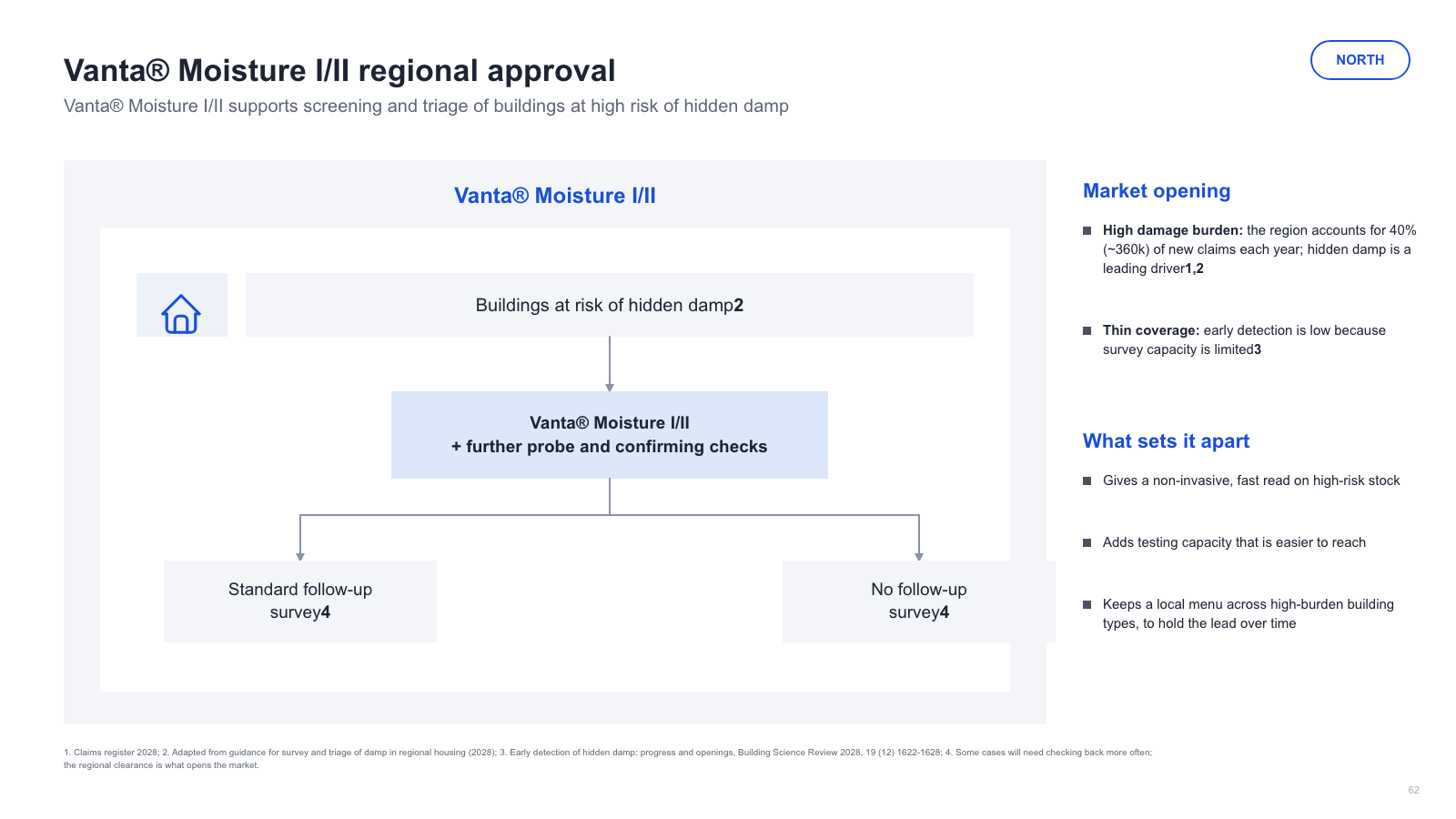
Grey panel holding a four-box screening flow beside a right column of headed bullet groups
1 slides · 1 credit
Check inputs & editing effort →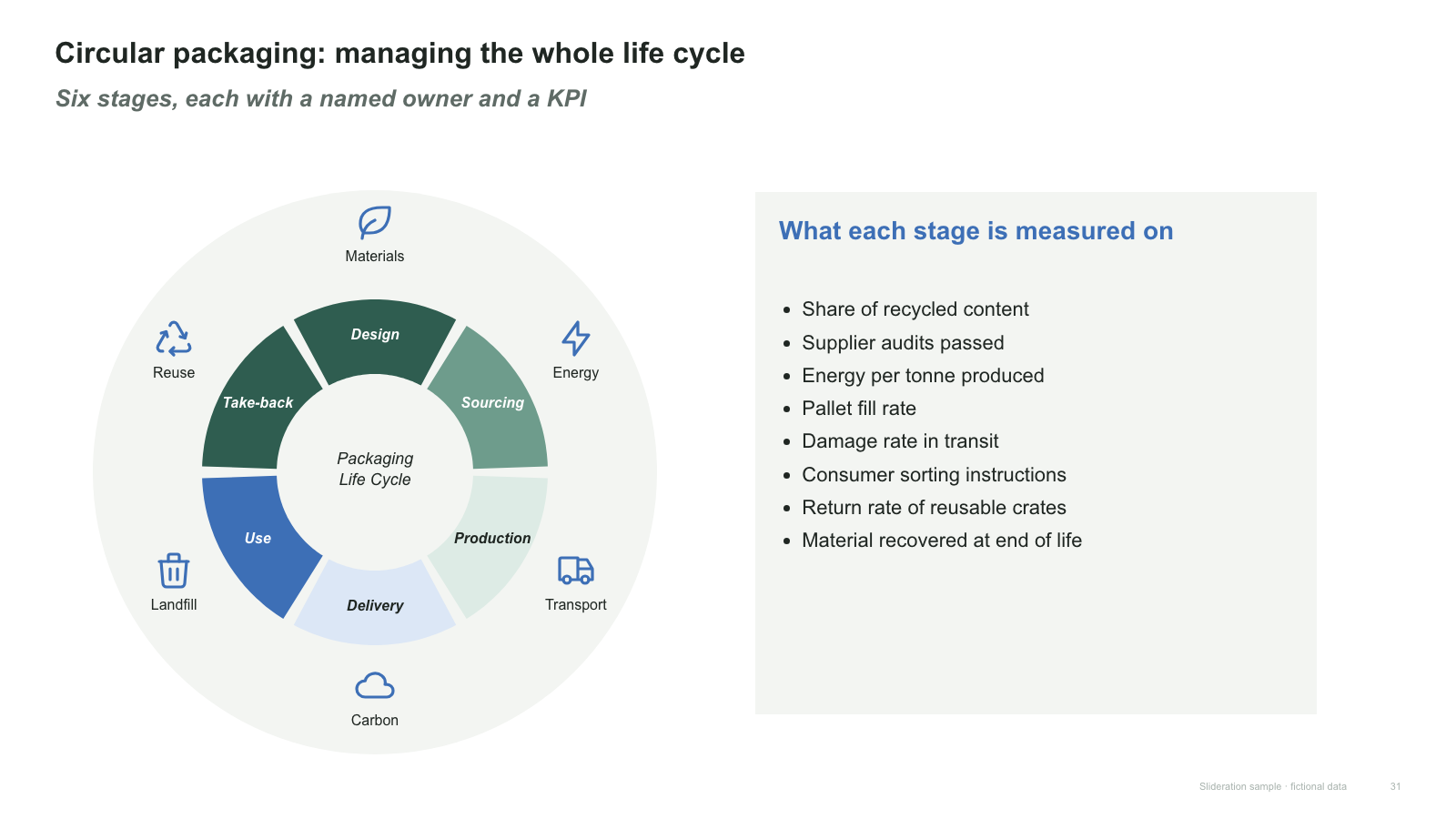
Six-segment life-cycle ring with outer icon labels + right panel list
1 slides · 1 credit
Check inputs & editing effort →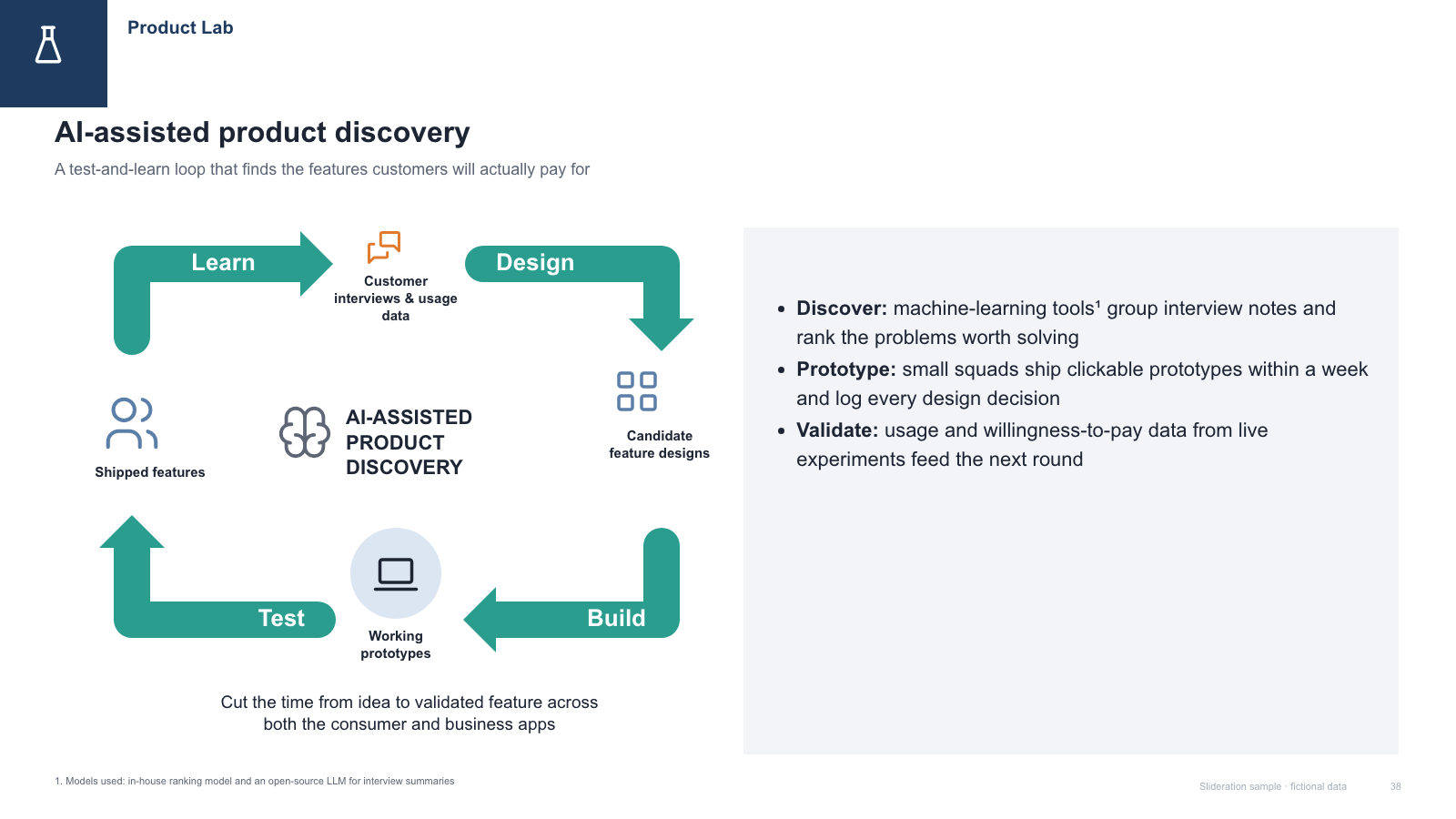
Four-arrow learn/design/build/test loop + right explanation panel
1 slides · 1 credit
Check inputs & editing effort →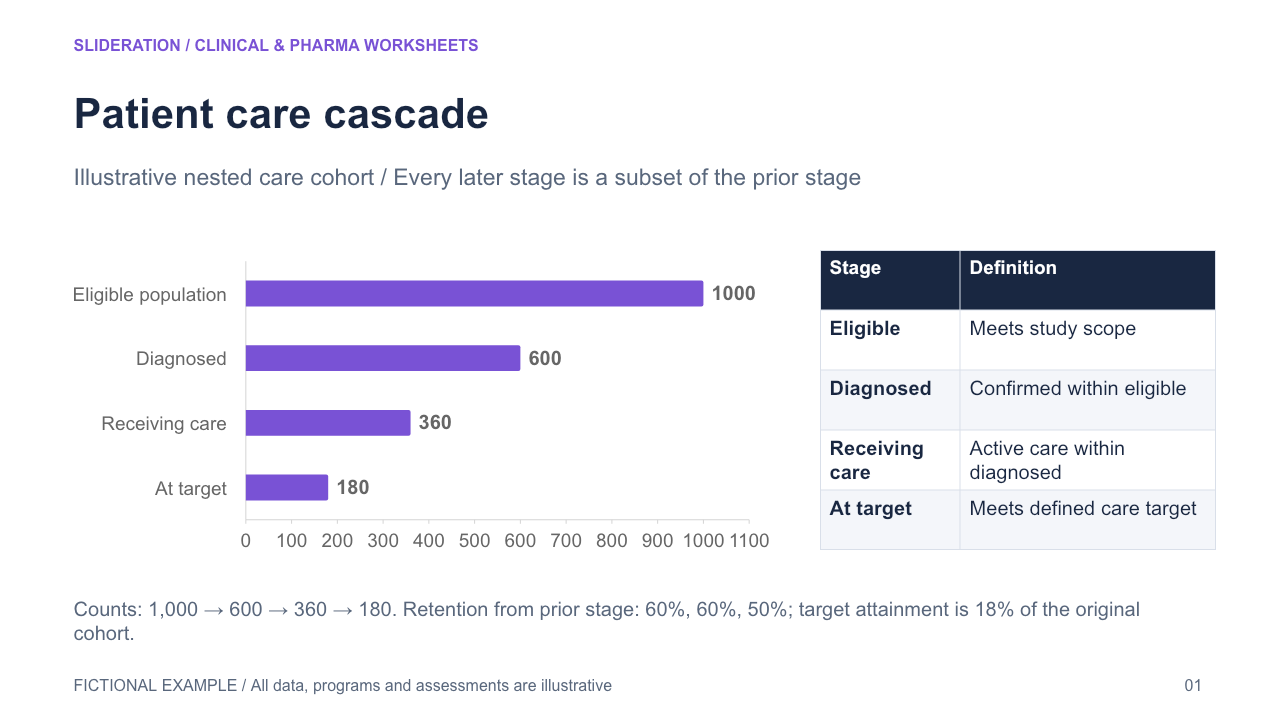
Patient care cascade — Nested cohort counts carry stage-specific definitions and denominator retention
2 slides · 1 credit
Check inputs & editing effort →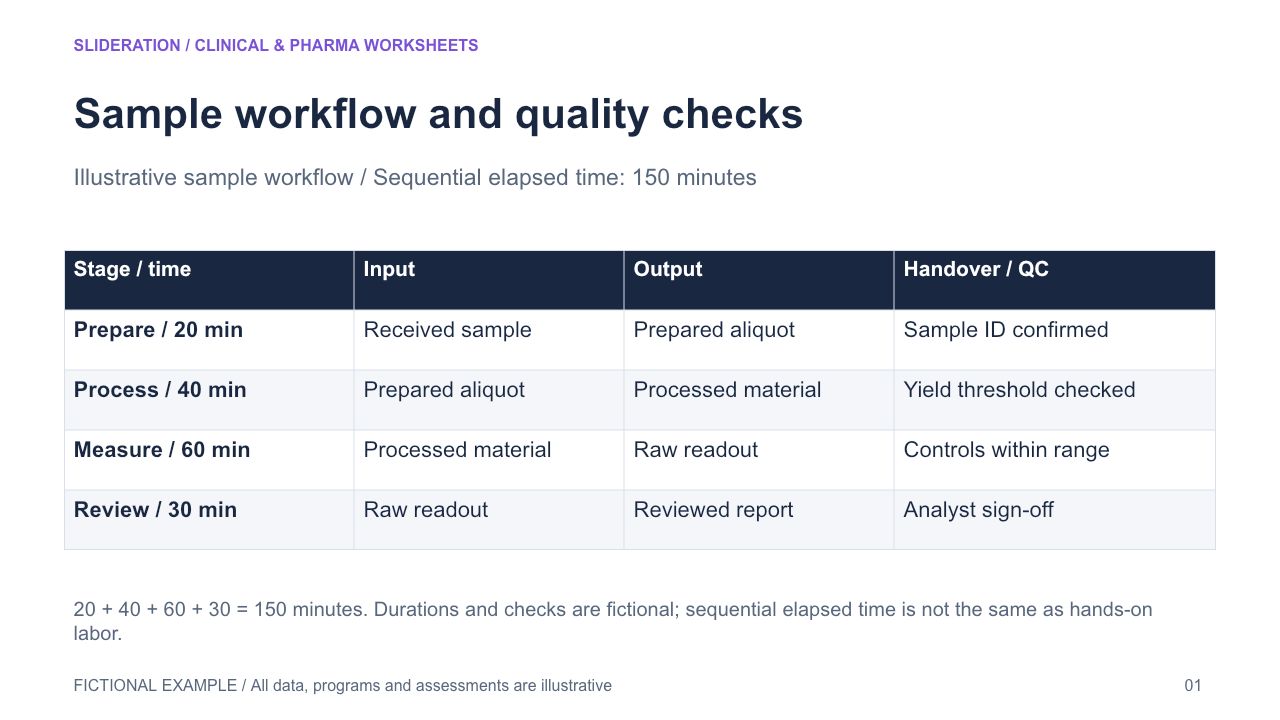
Sample workflow and quality checks — Stage input, output, timing and quality check define each handover
2 slides · 1 credit
Check inputs & editing effort →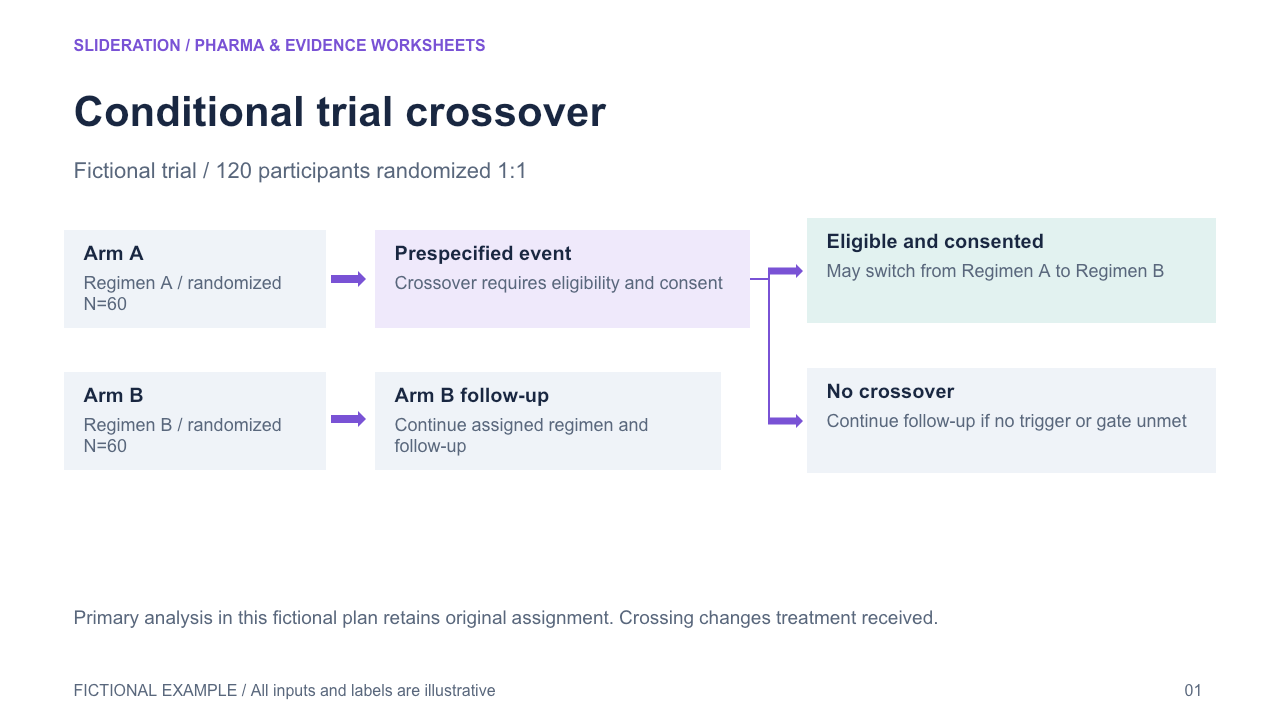
Conditional trial crossover — Randomized-arm lanes connect to a post-event eligibility gate, with optional crossover and no-crossover exits distinguished. Original assignment remains visible after treatment switches.
2 slides · 1 credit
Check inputs & editing effort →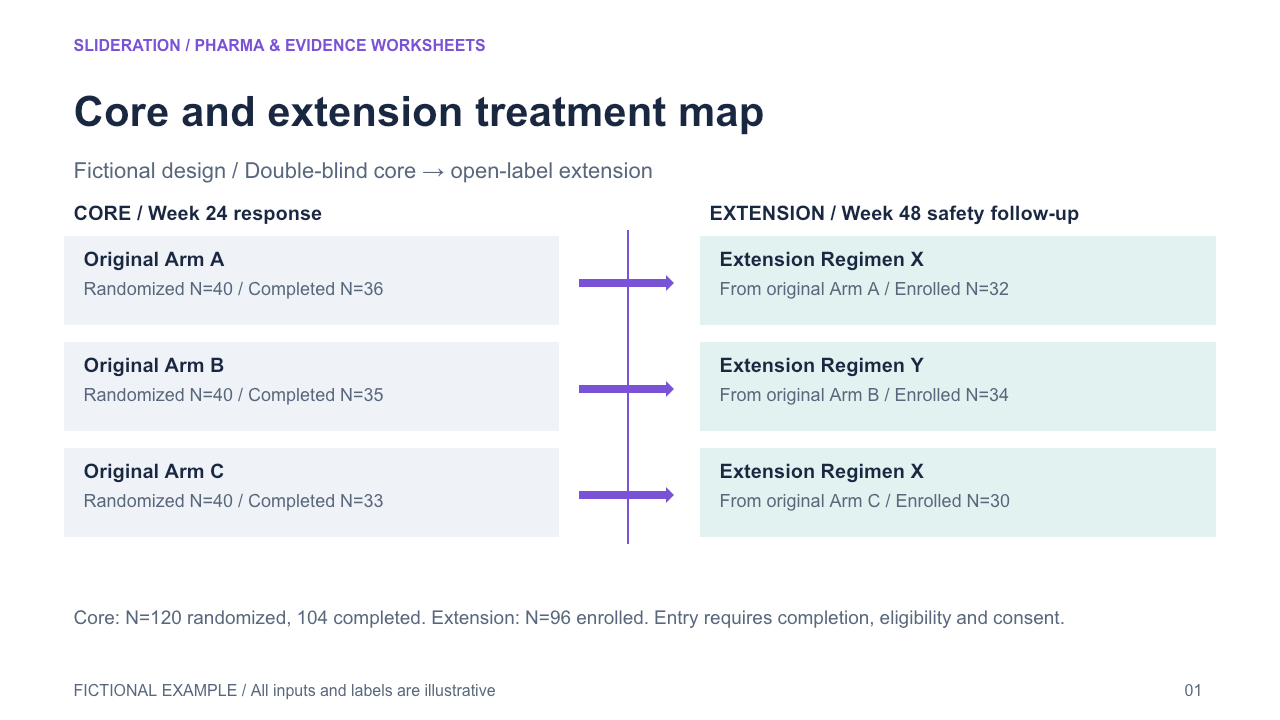
Core and extension treatment map — Each original core-trial arm maps to a separately labeled extension regimen across a core endpoint, eligibility/consent transition, extension window and safety follow-up. Core, completed and extension populations are distinct.
2 slides · 1 credit
Check inputs & editing effort →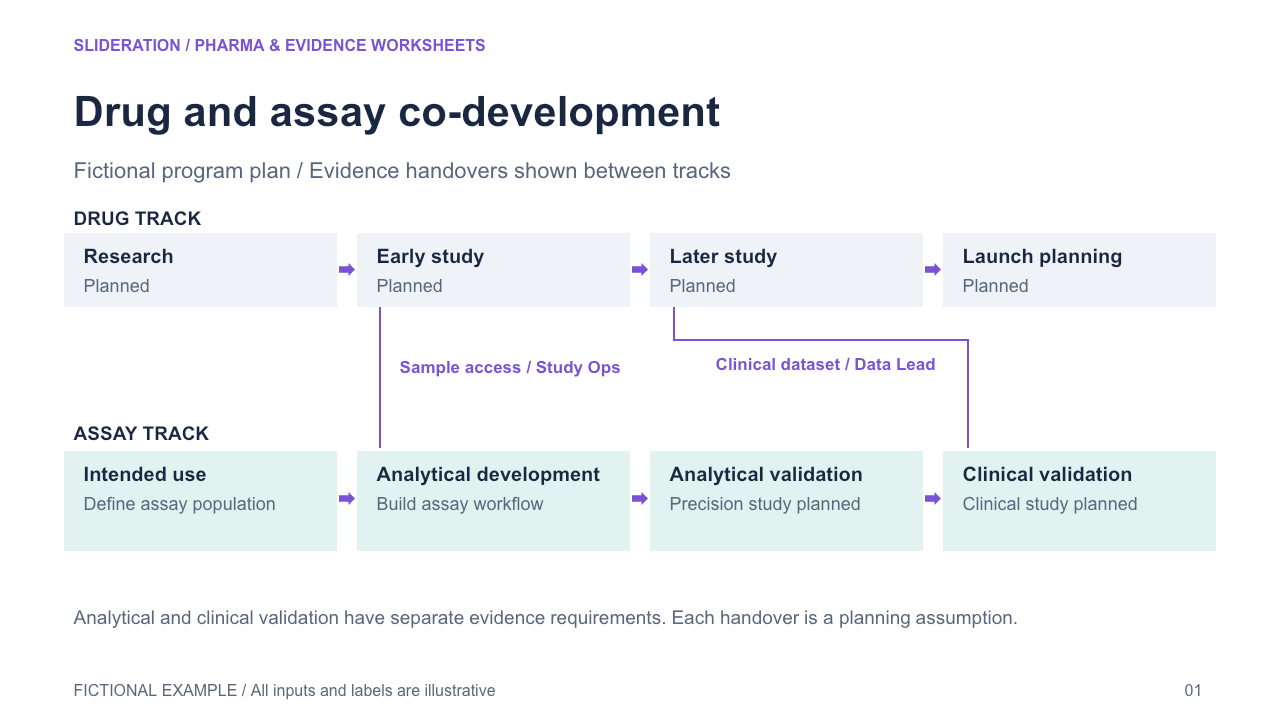
Drug and assay co-development — Drug-development and assay-development tracks have separate stage identities and planned evidence handovers; intended use, analytical validation and clinical validation are distinguished rather than collapsed into a generic launch date.
2 slides · 1 credit
Check inputs & editing effort →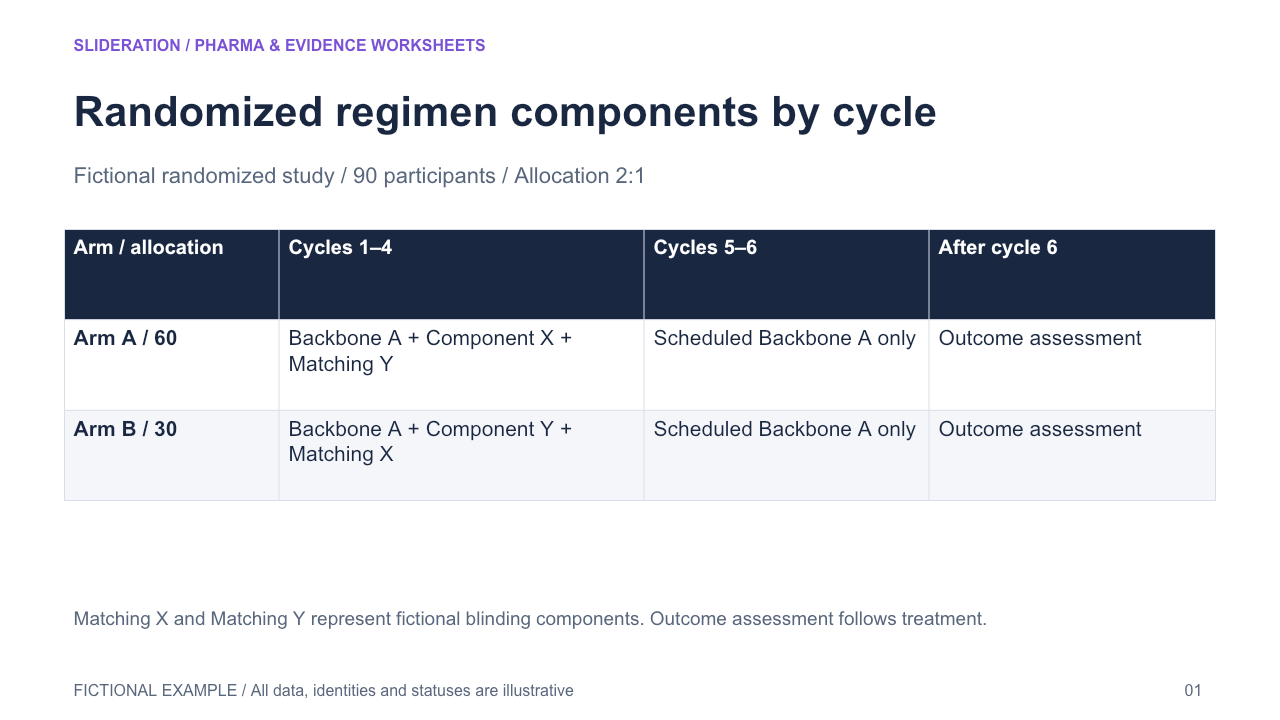
Randomized regimen components by cycle — Map randomized arms to the active, matching and shared components in each treatment-cycle window, then show whether the arms converge on a shared component or have different scheduled endings.
2 slides · 1 credit
Check inputs & editing effort →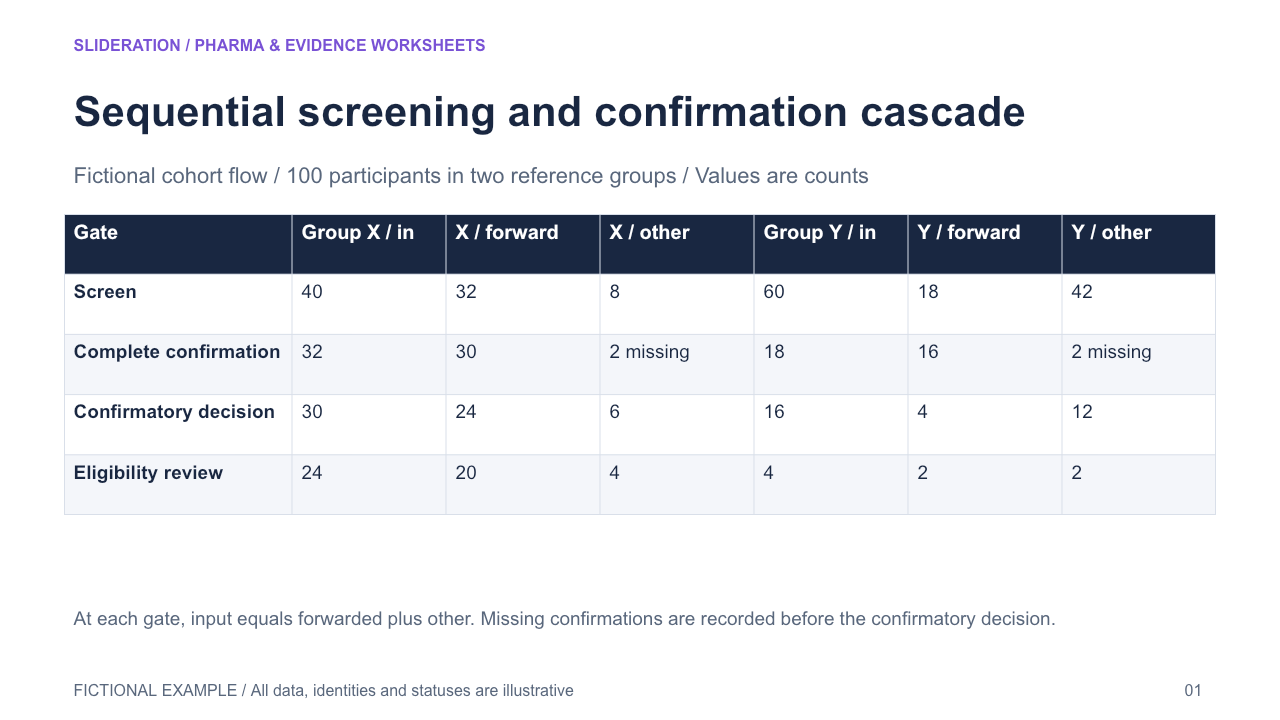
Sequential screening and confirmation cascade — Carry two reference-status cohorts through screening and confirmation, preserving the conditional denominator and non-forwarded groups at each gate before independent eligibility review.
2 slides · 1 credit
Check inputs & editing effort →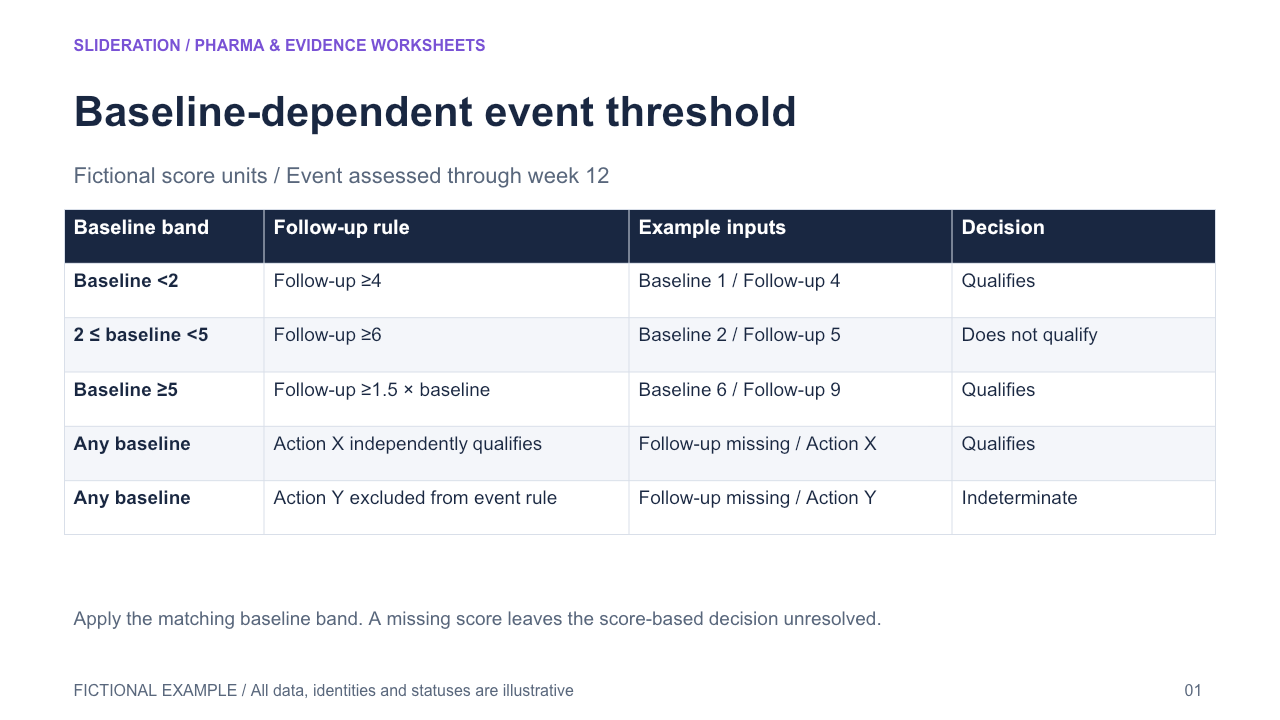
Baseline-dependent event threshold — Select a baseline band, apply its specific absolute or relative follow-up threshold, then evaluate any independently defined qualifying pathways and exceptions.
2 slides · 1 credit
Check inputs & editing effort →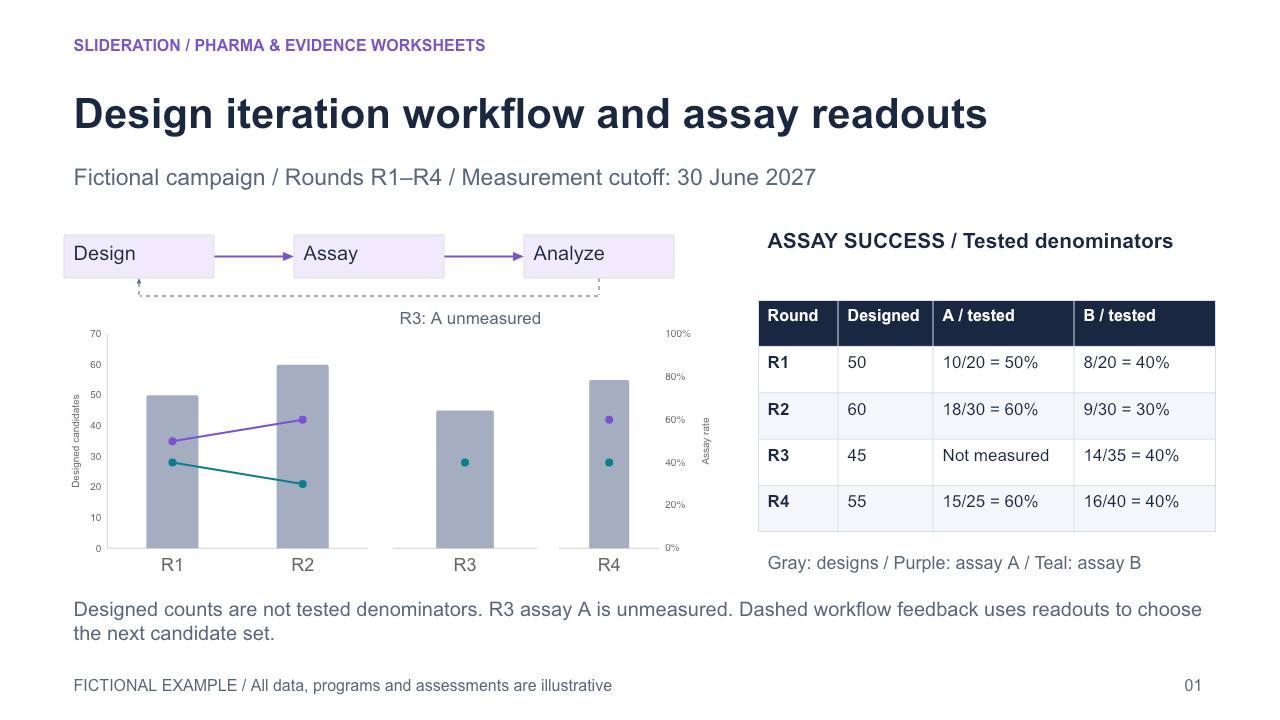
Design iteration workflow and assay readouts — Pair one experimental feedback cycle with measured results by iteration. Preserve the distinction between per-round design count and assay-specific rates, including each denominator and measurement cutoff. Existing templates provide the cycle, combo chart or stage handoffs separately.
2 slides · 1 credit
Check inputs & editing effort →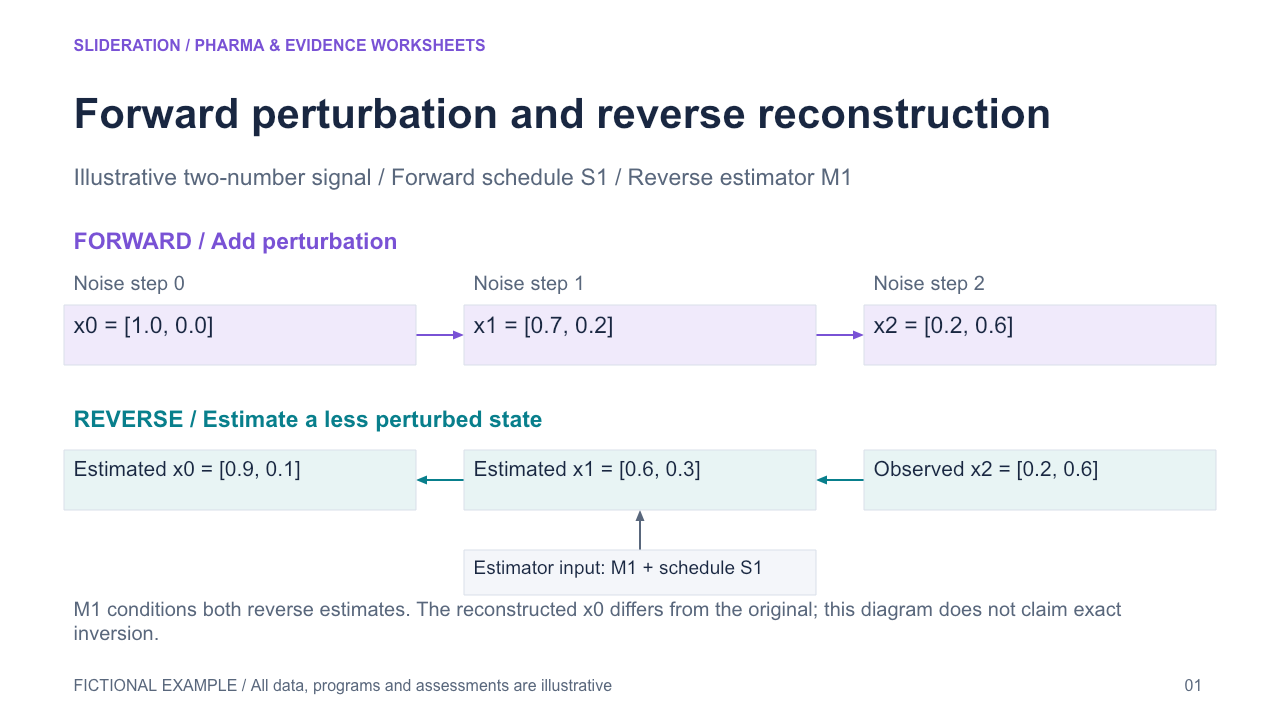
Forward perturbation and reverse reconstruction — Align matched states across a forward degradation track and reverse reconstruction track. The reverse transition has its own estimator input. A cycle or left-to-right process cannot express aligned inverse-direction tracks without structural redesign.
2 slides · 1 credit
Check inputs & editing effort →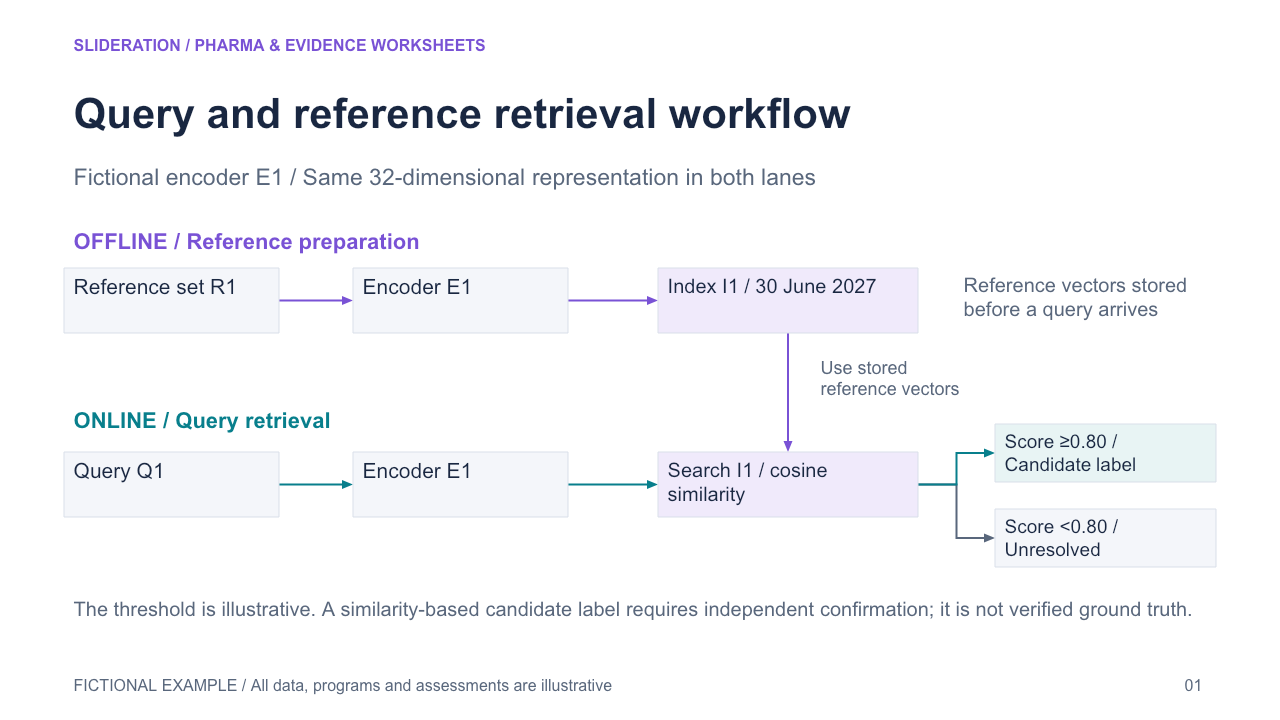
Query and reference retrieval workflow — Show online query encoding and offline reference encoding as separate lanes with the same embedding definition. The query lane retrieves from the precomputed reference index and returns a match or unresolved outcome. Existing source-to-database and device pipeline layouts lack the explicit query-to-index relationship.
2 slides · 1 credit
Check inputs & editing effort →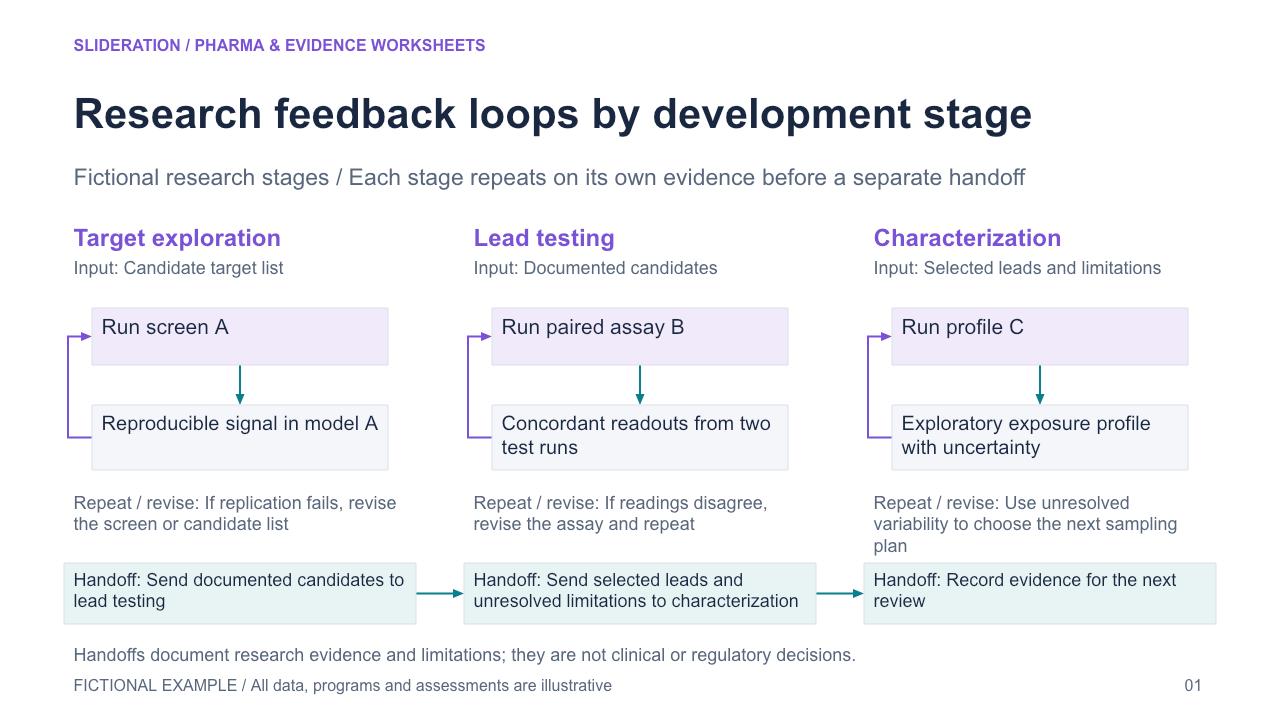
Research feedback loops by development stage — Show a separate experiment-to-analysis-to-next-experiment loop inside each research stage. Each stage has a measured output, feedback rule and separate handoff condition. The existing cycle and workflow templates show a single loop or linear handover, and the roadmap shows stages without internal iteration.
2 slides · 1 credit
Check inputs & editing effort →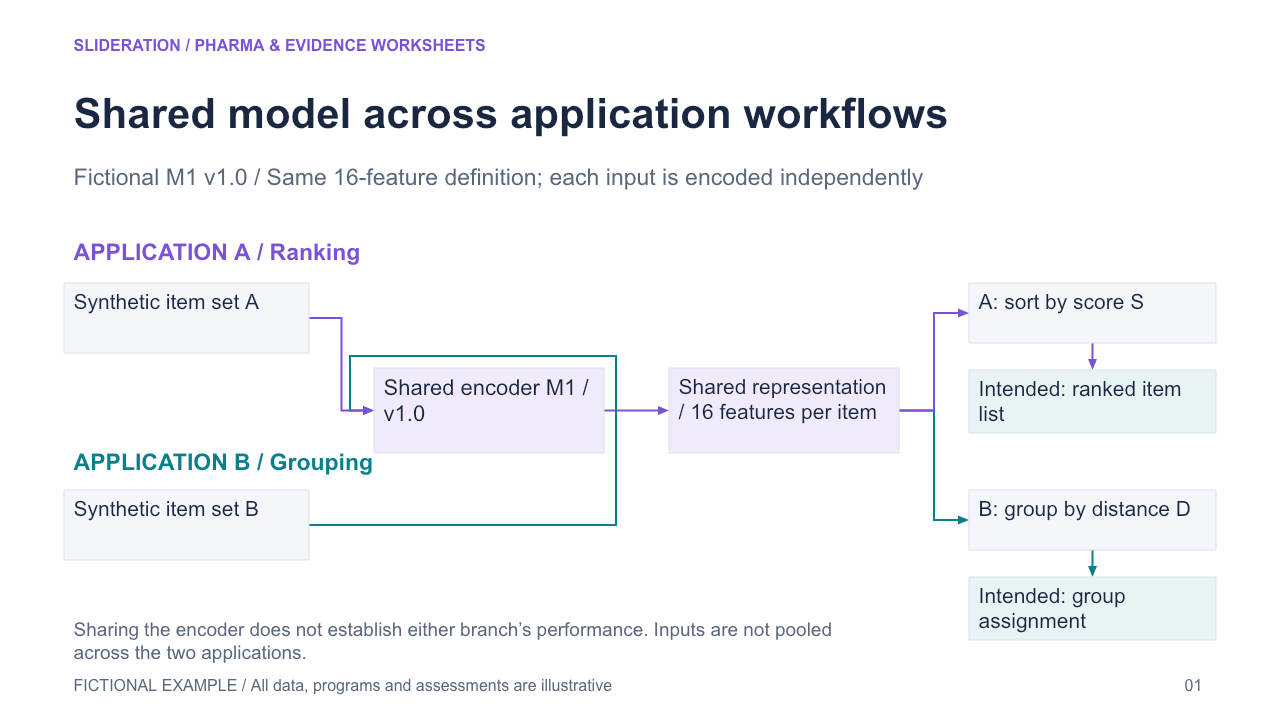
Shared model across application workflows — Align separate application lanes around one shared model and representation. Keep each lane’s input, downstream processing and intended output distinct. Unlike parallel independent workflows or online/offline retrieval, both paths use the shared model to deliver different outputs.
2 slides · 1 credit
Check inputs & editing effort →